
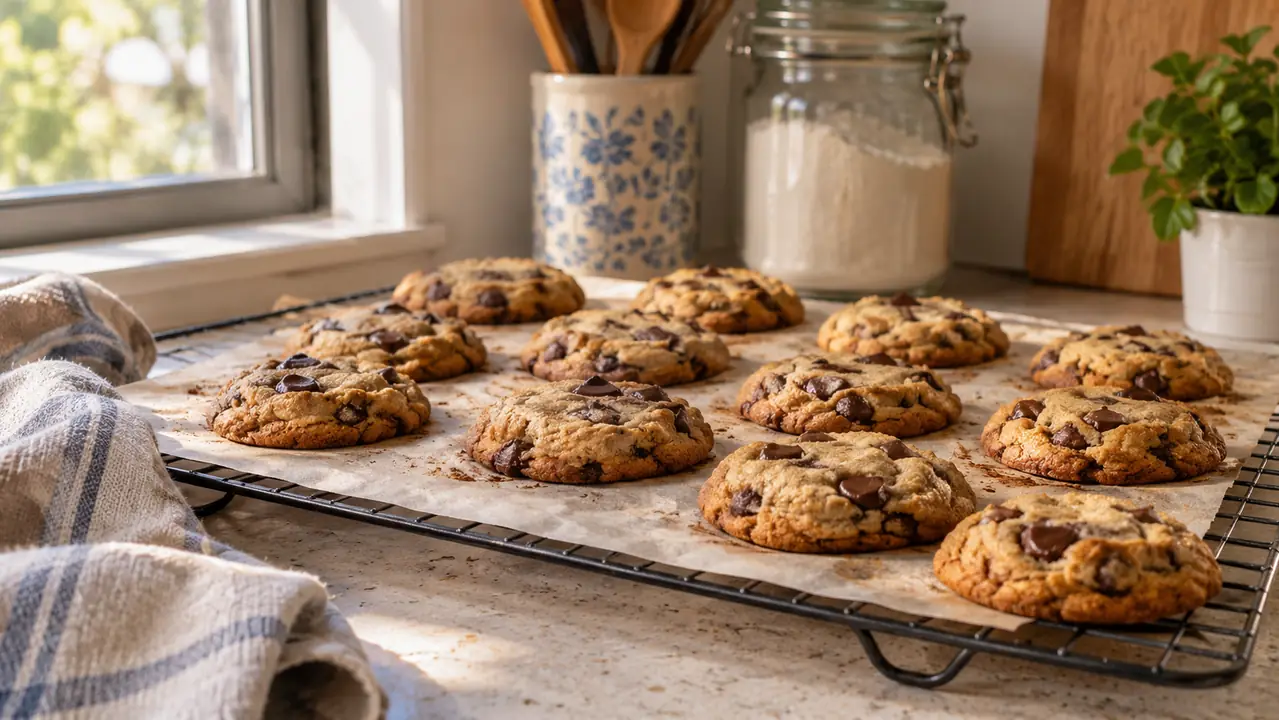
The first thing I do with any tray of cookies is look at the bottoms. Thirty years of weekend baking and I still check. The afternoon I pulled the first batch off this Nordic Ware half sheet, the bottoms were even across all twelve, no pale middle, no scorched row along the edge. For years I had blamed uneven browning on my own technique. It was the pan.
This is a long-term review of the Nordic Ware Naturals half sheet, the plain aluminum one sold two to a pack. I have been baking on a pair of them for four years, most weekends, in a small 1950s kitchen in Lancaster with a gas oven that runs about fifteen degrees hot and roughly three feet of usable counter. Cookies, roasted vegetables, sheet cakes for birthdays, rolls for Sunday dinner, and a good deal of parchment. I am not going to tell you a sheet pan changed my life. I am going to tell you what two of them changed in my baking, and where they still leave me doing the work.
The Quick Verdict
Four years, two pans, one hot oven. Even browning, no warping, and a rim that finally holds a parchment sheet flat.
Amazon Check Today's Price →Four years of weekend baking on one pair of pans
The two-pack means one tray in the oven and one cooling on the rack. Plain aluminum, no coating to wear through, and a lifetime limited warranty.
Amazon Check Today's Price on Amazon →How I've Used It
The pans came into the house in the fall, which is bake sale season here. Every October the church on the corner wants two hundred cookies and I have never once said no. That first year I ran both pans on the same afternoon, one going in while the other cooled, and finished the whole order in a single stretch instead of two evenings. My husband Dale, who retired from the machine shop and has opinions about anything with a surface, ate four cookies and said the edges were better. He was right. The edges were better.
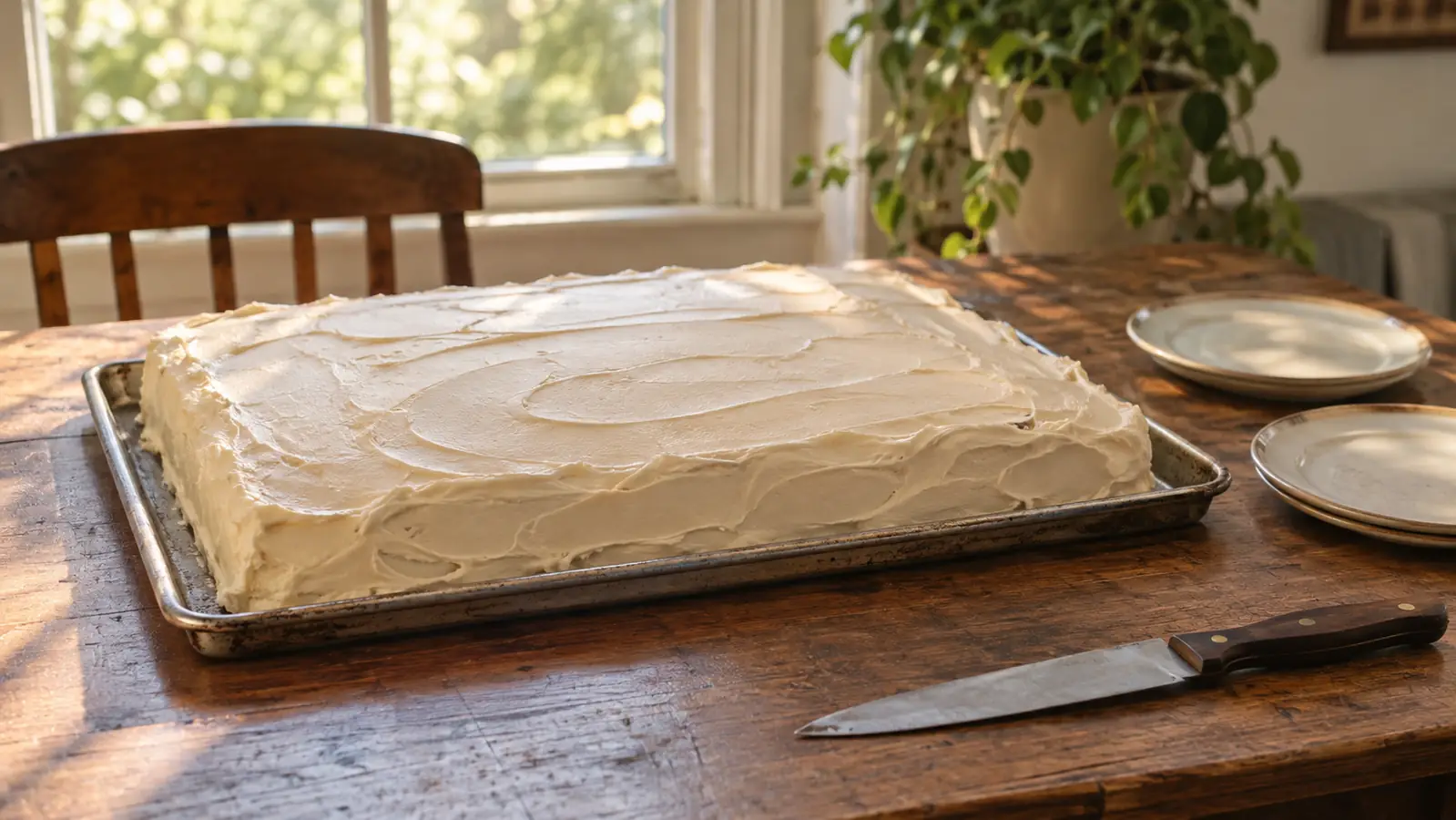
Since then they have handled a weekly rotation: chocolate chip and oatmeal cookies, roasted carrots and onions, chicken thighs with the skin on, a sheet cake for Dale's birthday in March, another when our daughter visits in summer, and a pile of dinner rolls every second Sunday. The pan goes into the oven empty to heat, comes out, gets a sheet of parchment, gets loaded, goes back in. I do not baby it. It has been dropped on the tile once and scrubbed more times than I can count.
Bake sale week I run four batches of chocolate chip and two of oatmeal in one long afternoon, twelve cookies to a pan, two pans working, and every tray comes out the same shade. Ten years ago I did the same order on two dark nonstick sheets and the batches did not match, one tray always a shade past where I wanted it. Nobody at a church sale mentions that sort of thing. I noticed. That difference is the reason I stopped shopping for pans and started paying attention to what the pan was made of.
What I noticed first was not the pan. It was that I stopped moving the tray around. With the old dark sheets I rotated halfway through and still got a hot corner, because the pan held heat unevenly and the finish scorched before the cookie set. These are pure aluminum, and they conduct heat fast and give it up fast. The cookies set before the bottom has a chance to run ahead of the top, and that is the whole difference between a tray I have to watch and a tray I can walk away from.
What Pure Aluminum Does to a Cookie
Aluminum is the reason. It moves heat quickly and evenly, so the entire surface of the pan comes up to temperature at close to the same moment. That is why the browning is even and why the pan feels hot so fast when you pull it out of the oven. It also means there is no coating sitting between the dough and the metal. Nothing to wear through, nothing to peel at the corners after a hundred washes, and nothing that turns a four-year-old pan into something you have to replace.
Because there is no coating, you also get a pan you can run under the broiler without wondering what the finish will do. I do that with chicken thighs and with a tray of halved tomatoes at the end of summer, when the garden is producing faster than we can eat. I tested the broiler line once on purpose with halved plum tomatoes and walked away for four minutes, longer than I meant to. They came back blistered and browned at the edges and the pan was fine. On a coated sheet I would have been watching that whole four minutes for the finish to bubble.
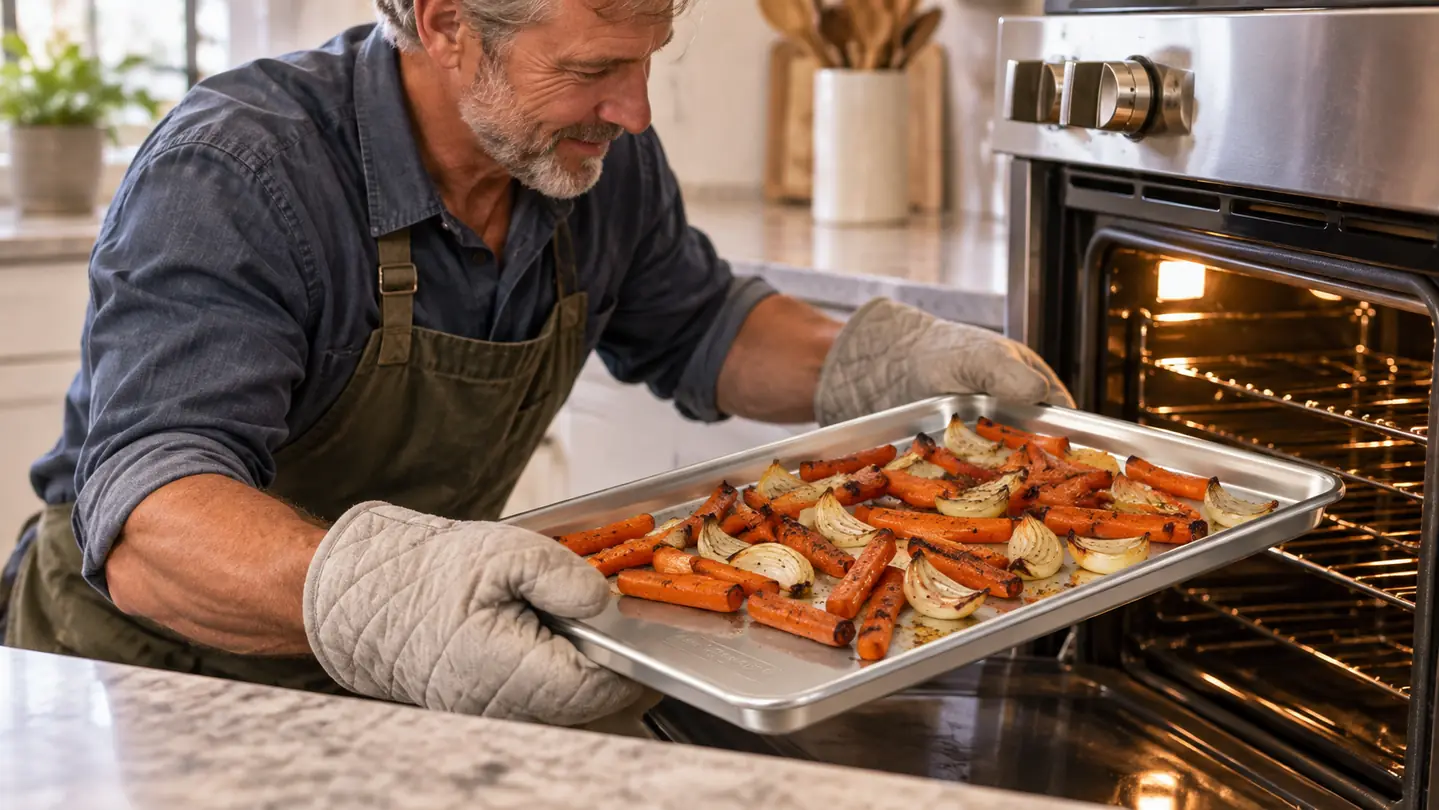
Roasting is the other half of the job and it behaves the same way. Carrots at 425 for twenty-five minutes, tossed once, come out caramelized on the flat side and still firm in the middle, and the pan soaks for five minutes and then wipes clean with a nylon scrubber. The trade is that bare aluminum is not nonstick. Cookies with a decent amount of butter release cleanly on their own; anything sticky needs parchment or a thin smear of shortening. I use parchment for probably eight bakes out of ten and never think about it.
The thing I did not expect is how much better the pan is at the second job. A half sheet is a work surface. I rest roasted meat on it, I catch the drips under a pie, I spread bread crumbs out to dry. The one inch sides are high enough to hold a loose pile of vegetables and low enough that a spatula slides straight off the edge. The interior measures about 17.1 by 12.1 inches, the exterior 17.9 by 12.9, and that is the standard half sheet size that fits a home oven with room to spare around it.
The Rim, the Warp, and My Fifteen-Degree Oven
Every thin sheet pan I have owned died the same way. You hear a bang halfway through a bake and the pan has popped into a shallow bowl, and from then on one end of every cookie is darker than the other. I had one go in 2009 with a batch of bar cookies in it, and the bang was loud enough that Dale came in from the garage to ask what I had dropped. That pan stayed in the cupboard two more years out of pure stubbornness and I regret all of it. Nordic Ware handles the problem with an encapsulated galvanized steel rim, which is the reason the sides stay where you put them. Mine have gone from a cold counter into a hot oven hundreds of times and I have never heard that bang.
When I unboxed the pair, the first thing I did was put both thumbs into the middle of one and try to flex it against the counter. It did not give at all. That is not a scientific test and I would not present it as one, but it told me what I wanted to know before I ever turned the oven on. The rim is also the part I grip through a towel, and it has not bent under my hand in four years of handling.
My oven runs fifteen degrees hot, which I found out years ago with an oven thermometer and have confirmed twice since. I set it low by fifteen and bake on the middle rack. With these pans, that is the whole adjustment. Twenty-four cookies across two trays, twelve minutes, rotate once at the halfway mark out of habit more than need. Dale can tell the difference between a batch I rotated and a batch I forgot about. With these pans he cannot, which is a small mercy for both of us.
The two-pack matters more than I expected. Half sheet pans are the workhorse size and one is never enough. One loaded tray in the oven, one cooling on the rack, and by the time the first is done the second is ready to go in. Bake sale week means three batches back to back without ever waiting on a pan to come down to room temperature. If I had bought a single pan I would have bought a second within a month, and that is the most practical argument for the pair.
Cleaning, Scratching, and Year Four
I wash mine by hand. Warm water, a little dish soap, a nylon scrubber, dry with a towel, back in the cupboard under the oven. It takes under a minute and I have never had a reason to change the routine. I tried the dishwasher exactly once, in the first winter, mostly out of laziness. The pan came out with a chalky film and a few water spots that took a vinegar wipe to lift. Nothing was ruined and nothing peeled, I just did not see the point, since washing by hand is faster than unloading the machine anyway.
Mine are scratched now, four years of metal spatulas and one memorable incident with a bread knife, and the scratches have not changed a thing about how they bake. That is the difference between a coating and a material. A scratched nonstick pan is a pan you throw out. A scratched aluminum pan is a pan with a history, and it browns a cookie the same as it did on day one.
The pans also carry a lifetime limited warranty and they will not rust. I live in a house with a damp cellar and a cupboard that collects condensation in July, and neither pan has a spot of rust on it. The maker says they are made in America of domestic and imported materials, which I checked before I ordered, and I like knowing that. I also like that there is no finish to fail, so the pan at year ten should behave like the pan at year one.
Storage is the other thing I care about in a small kitchen, and these stack. One nests inside the other with the parchment left in, and the pair slides into a narrow slot beside the refrigerator where a bulky set would not go. I have three feet of counter and no pantry, so a pan that stacks is a pan that gets used. A pan that has to be moved out of the way to reach something else is a pan that stays in the cupboard until the holidays.
Four years, two pans, hundreds of trips into a fifteen-degree-hot oven, and I have never once heard the bang of a warping tray.
What These Pans Do Not Fix
I want to be straight about this, because I spent years buying gear instead of practicing. A good pan browns evenly. It does not make an under-mixed batter behave, it does not rescue a recipe with too much sugar, and it will not level a rack that sits crooked in an old oven. I still weigh my flour, I still chill cookie dough for an hour before it goes on the pan, and I still set a timer and then set a second one because I do not trust the first.
I have bought three things over the years hoping they would make me a better baker: a stand mixer, a marble slab, and a set of heavy dark pans. The mixer earned its place and I use it twice a week. The other two did not change a single result, because the problem was my measurements and my oven, not my equipment. That is the honest frame for this pan too, and it is why I have not bought a fourth thing to fix what a scale and an oven thermometer already fixed.
The other limit is size. A half sheet fits a home oven, and that is the trade. It is not a full commercial sheet, so a very large batch of cookies is two trays, not one. If you regularly bake for a crowd, you will eventually want a second pair. And the pans need handling with a dry towel or a decent mitt, because bare aluminum gets hot fast and stays hot, which is the same property that makes it brown so well in the first place.
One more, and this matters to some people more than it should. They mark. They take on the look of something that lives in a working kitchen rather than something from a display shelf. If you want a pan that still looks new at year five, this is not that pan. I would rather have the even browning and the scratches, but it is an honest trade and you should know it going in.
What I Liked
- Even browning from edge to edge once you know where your oven actually runs
- Encapsulated galvanized steel rim, and mine have not warped in four years
- No coating to chip or peel, so scratches do not end the pan's life
- Two pans in the pack, which is the number you actually use
- Stacks flat in a small kitchen and lives in one narrow slot
- Will not rust, and it carries a lifetime limited warranty
Where It Falls Short
- Not nonstick, so sticky doughs need parchment or shortening
- Marks and scratches show and stay
- Bare aluminum gets very hot and needs a dry towel or a good mitt every time
- A half sheet is still two trays for a big cookie batch
Who This Is For
If you bake most weekends and you are tired of turning a tray and still getting a dark corner, this is the Nordic Ware pan I would put in your hands. It suits anyone working in a normal home oven who wants one size that does everything: cookies, roasted vegetables, sheet cakes, rolls, a tray of bacon on a Sunday morning. It suits a small kitchen, because two pans stack in the space of one. And it suits anyone who has thrown out a sheet pan because the finish went before the pan did, which is most of us at least once.
Who Should Skip It
Skip it if you want a pan you can wipe with a paper towel and put away, because bare aluminum is not that. Skip it if you bake once a year at the holidays and already own a battered sheet, because a new pan will improve your cookies by a small amount and your life not at all. Skip it if you need a full commercial size, or if a dark finish is doing something specific for your bread crust. And skip it if you are not willing to learn where your oven actually runs, because this pan will show you whether you want to know or not.
The pan I would buy again, four years in
Plain aluminum, two to a pack, an encapsulated rim that holds its shape, and no coating to wear out. Mine are scratched and they still bake the same.
Amazon Check Today's Price on Amazon →