
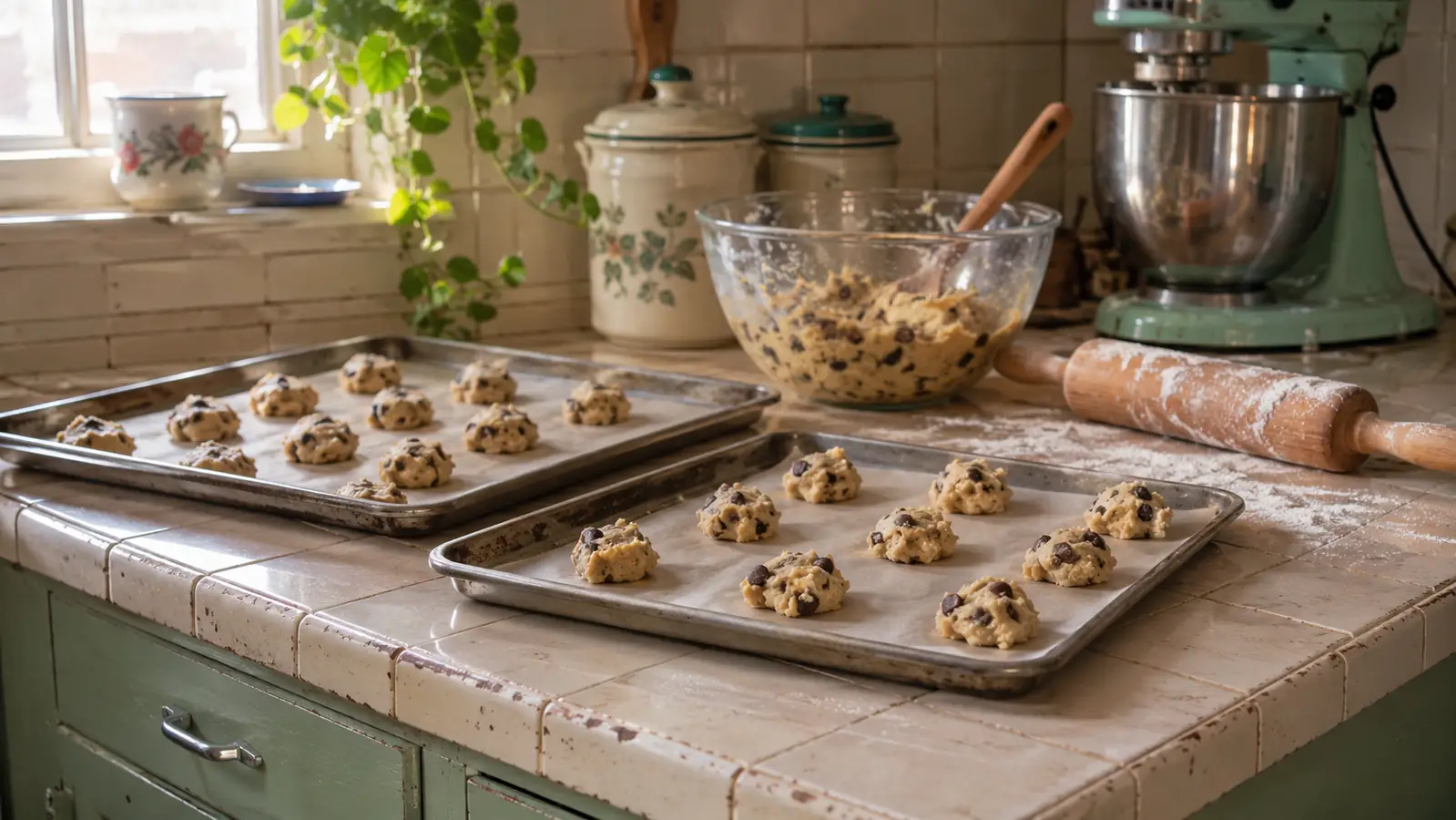
Here is the short answer, and it comes from six years of weekend baking on one usable stretch of counter. If you want a pan that browns evenly, goes into a hot oven without buckling, and is still the same pan in ten years, buy the Nordic Ware half sheet. If the things you bake most are lemon bars, brownies, and a cake you would rather not line with parchment, a dark nonstick sheet will save you time and a certain amount of muttering. They are different tools. Most bakers end up wanting one of each, and if you can only buy one, the aluminum pan is the one that keeps earning its place.
I keep both, and both get used most weeks. The Nordic Ware half sheet is the Naturals model, sold as a two-pack, 17.9 by 12.9 by 1 inch on the outside and 17.1 by 12.1 by 1 inch inside. It is pure aluminum with a galvanized steel rim encapsulated in the edge, which is the part that keeps the pan flat when it comes out of the oven. The nonstick pan in my drawer is a Wilton, the dark coated half sheet sold in every craft store in Lancaster. Same recipes, same oven shelf, same gas oven that runs about fifteen degrees hot. What separates them is not quality. It is what you are asking the pan to do.
| Nordic Ware Half Sheet | A Nonstick Half Sheet | |
|---|---|---|
| Material | Pure aluminum, no coating, encapsulated galvanized steel rim | Steel with a dark nonstick coating baked onto the surface |
| Even browning | Heats edge to edge, nothing between the metal and the dough | Runs hot at the corners, cooler through the middle of the tray |
| Release with no liner | Needs butter, parchment, or a silicone mat | Sticky bars and brownies lift out bare, cleanly |
| Warping | Came out of a 425 degree oven flat every time in three months | Popped twice on a cool counter, and both times it stayed twisted |
| Metal utensils | Spatula, bench scraper, even a knife, all fine | Coating scratches and flakes wherever metal digs in |
| Cleanup | Easy if you wash it the same night, acid will pit it if you do not | Wipes out in under a minute, hand wash only |
| Lifespan | Lifetime limited warranty, does not rust, six years and counting | Release fades in two to three years, then the pan gets replaced |
| Best for | Cookies, roasted vegetables, sheet pan dinners, anything you want crisp | Lemon bars, brownies, caramel slice, anything sugary and sticky |
How I Compared Them
I did not run a laboratory. I ran a rotation. From January through March I baked the same three things in both pans on alternating weekends: a batch of chocolate chip cookies, a tray of roasted root vegetables for Sunday supper, and lemon bars, which I made four times because Dale kept saying the first three batches were fine and I did not believe him. I wrote down whether the bottoms of the cookies matched the tops, whether the outer cookies on the tray set before the middle ones, how each pan came out of the oven, and how long the washing up took.
Dale is retired from the machine shop and has opinions about metal that he usually keeps to himself. I asked him to look at each pan on the counter after it came out and tell me whether it looked flat to him, without telling him what I had seen. He caught both warps on the nonstick pan before I said a word. That is not a measurement, but thirty years of watching steel cool is worth something, and it matched what I found the next morning when I set a straight edge against the pan.
Where the Nordic Ware Half Sheet Wins
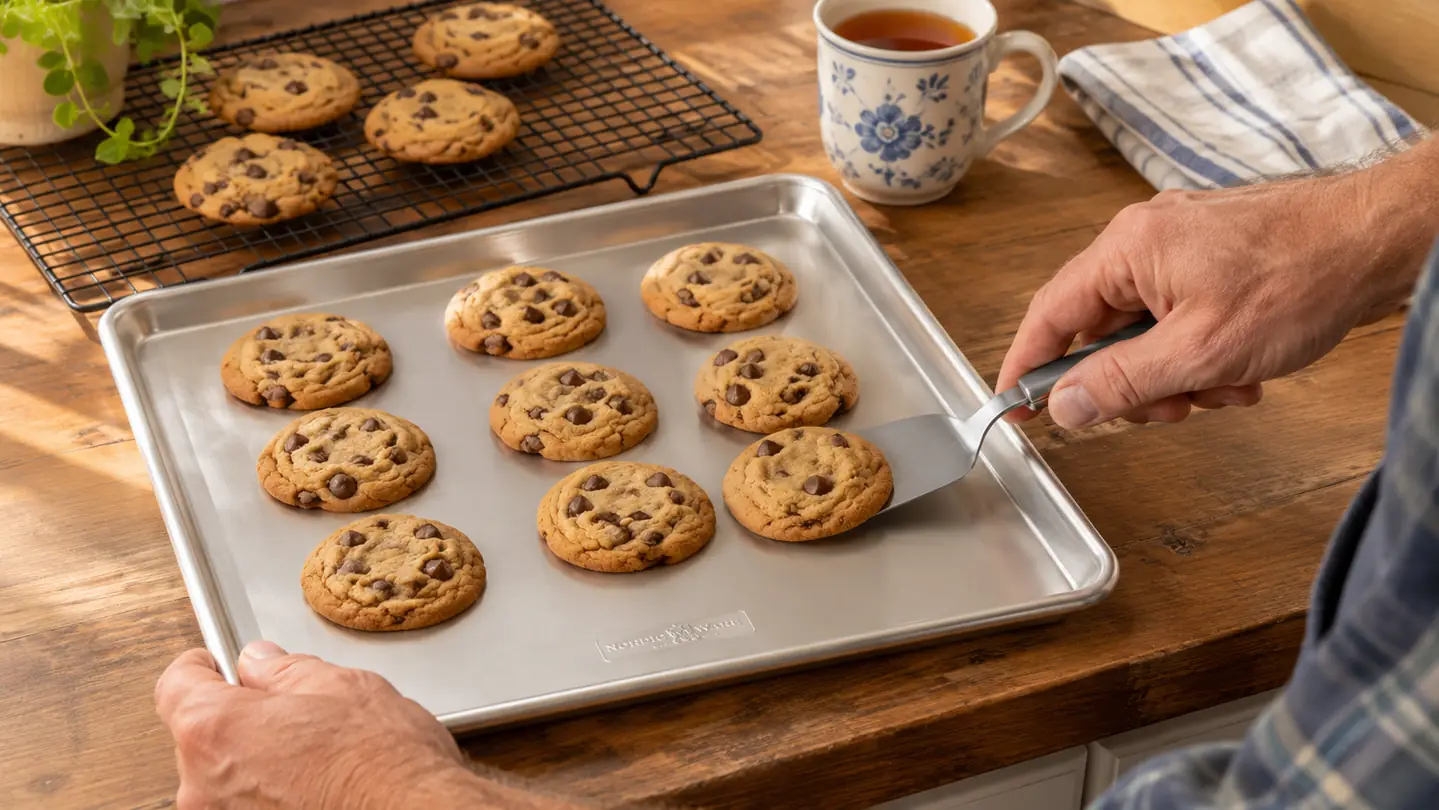
Browning, first. Pure aluminum moves heat into food quickly and evenly, and there is no coating between the metal and the dough, so the bottom of a cookie sets at roughly the same rate as the middle. The nonstick pan behaves differently. The dark coating pulls heat into the surface fast, and the tray runs hot near the edges and cooler toward the middle. My first batch on that pan came out with the four corner cookies already dark while the center ones were still pale and soft. I spent a month rotating the pan and shuffling cookies around like checkers before I accepted that a light, uncoated pan simply bakes a more even batch.
Second, heat. The encapsulated steel rim is the reason this pan comes out of a 425 degree oven flat and can sit on the stovetop while I make a pan sauce from the drippings. The nonstick pan has popped twice, both times when I set it down on the cool granite counter, and once it popped hard enough to send a roasted carrot onto the floor. Warping is not cosmetic. A pan that has twisted never sits flat again, and everything you bake on it browns harder on the high side, which is a defect you cannot correct with technique.
Third, it does not wear out. There is no coating to scratch, so a metal spatula is fine and a bench scraper is fine, and if I cut bars in the pan with a paring knife I am only marking metal rather than ruining a surface. Nordic Ware covers it with a lifetime limited warranty, and the pan does not rust. Six years in, mine has a mottled patina from years of sheet pan dinners and it bakes exactly as it did the first week. It is also the pan I hand to guests who offer to help, because there is nothing they can do to it.
Where a Nonstick Sheet Wins
Release, and I am not going to be clever about it. Lemon bars come out of the nonstick pan in one piece with nothing underneath them. On the aluminum pan the same recipe needs parchment or it welds itself into the corners and I lose the first bar to the spatula. Brownies, caramel slice, anything with enough sugar and butter to set as it cools, the nonstick pan wins outright, and it wins by enough that I stopped testing that recipe on aluminum after the second try.
Speed of cleanup is the other one, and it is not close. A nonstick sheet wipes out with a soapy sponge in under a minute and never needs soaking. Aluminum is not difficult, but it is not instant either, and it does not forgive neglect. Tomato, lemon, and vinegar will pit the surface if they sit on it overnight, so a sheet pan dinner with lemon and onions has to be washed the same evening. If you are the kind of cook who leaves the pan until morning, the nonstick pan absorbs that habit and the aluminum pan punishes it.
The pan that has never been replaced in my kitchen
Pure aluminum, a rim that keeps it flat, and no coating to wear through. It comes as a two-pack, so one is in the oven while the other cools on the rack.
Amazon Check today's price on Amazon →What the Coating Costs You Over Time
A nonstick coating is a wear item. It starts out slick, gets less slick after a hundred washes, and somewhere around the second or third year it goes patchy in the spots where a spatula works hardest. My first nonstick half sheet lasted a little over two years of weekend use before the corners went dull and brownies began to stick in exactly the places the coating had thinned. The second one is heading the same way. There is no repair for this. When the release goes, the pan becomes a pan you line with parchment, which means you are back to doing what the aluminum pan required all along, on a surface that has to be replaced again.
Aluminum has its own version of wear, but it is cosmetic and then it stops. The surface dulls, takes on stains, and develops a patina that no amount of scrubbing brings back, and after that nothing much changes. Six years in, the Nordic Ware pan has outlasted two nonstick sheets in this kitchen and shows no sign of quitting. That is the difference between a pan that ages and a pan that expires.
A nonstick pan never fails all at once. It just gets less slippery until the day the brownies stick, and then it is a pan you line with parchment anyway.
Cleanup, and the Habit That Actually Matters
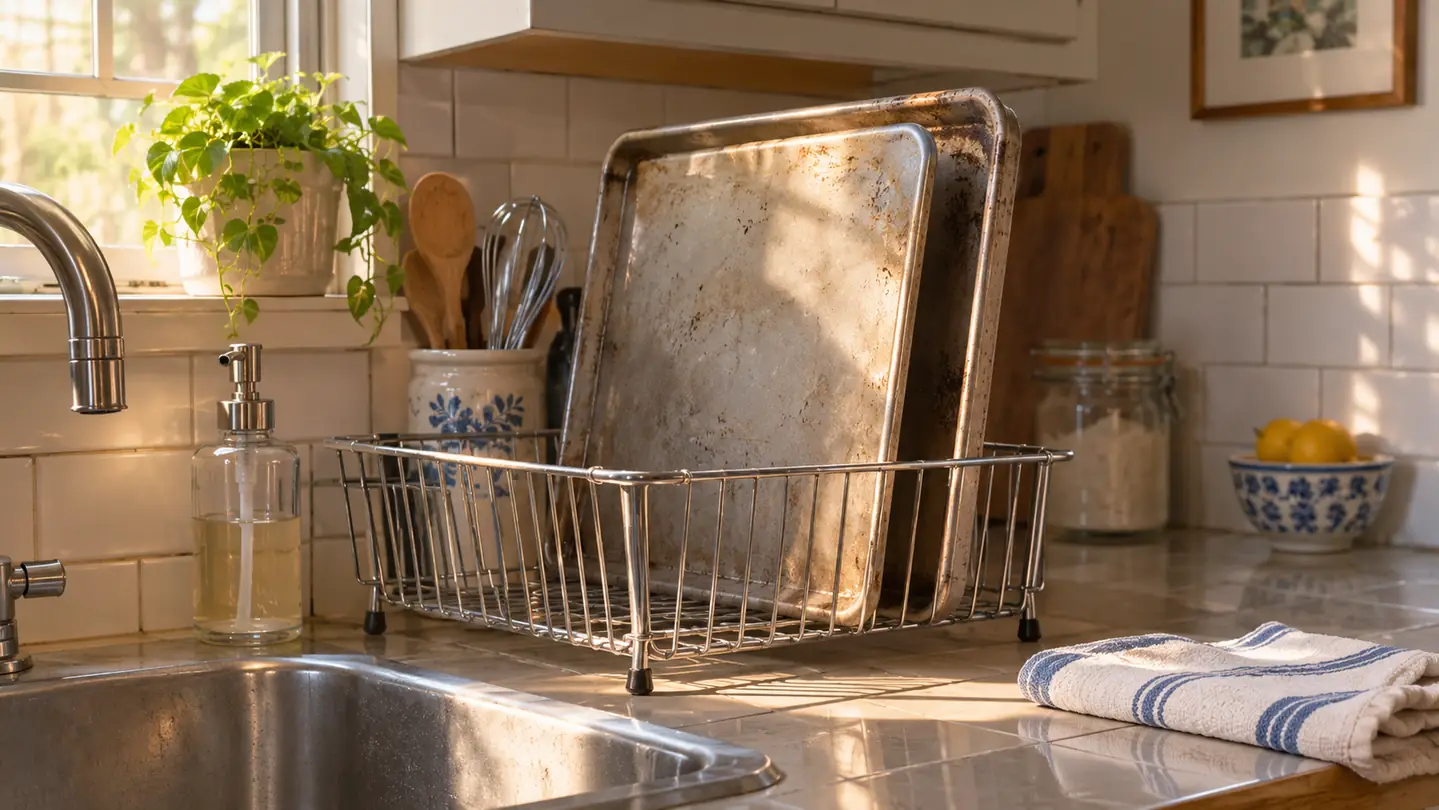
The practical difference between these two pans comes down to one habit: whether you wash the pan the same night. Both are hand wash, and neither belongs in a dishwasher if you want it to last. With the nonstick pan, a sponge, warm water, and forty seconds does it. With the aluminum pan, the same forty seconds works if you get to it before the fat sets, and a ten minute soak handles the rest. What aluminum will not tolerate is acid left sitting on it, which is the one thing I wish someone had told me when I started.
I keep a stack of parchment squares cut to size for the aluminum pan, which sounds fussy and takes about two minutes on a Sunday afternoon. That is the trade. The nonstick pan saves you the parchment and costs you a replacement every couple of years. The aluminum pan costs you parchment and keeps going. Neither is free, and which one you should pick depends on which of those two chores you resent less.
Size, Storage, and a Small Kitchen
My kitchen is a 1950s galley with about two feet of usable counter, so footprint matters as much as performance. Both pans are half sheet size, which is the size that fits a standard oven rack with room for air to move around the edges, and the one inch rim on the Nordic Ware pan is what makes it useful beyond baking. It holds a pile of chopped root vegetables and chicken thighs without anything spilling over, and it doubles as the roasting pan for a weeknight dinner when I do not want to wash a second dish.
Storage is where the two-pack earns its keep. Two aluminum sheets stack in a cabinet corner without scratching each other, and when one is in the oven the other is on the rack cooling cookies, so a double batch never involves a pause. The nonstick pan has to be stacked with a towel between it and whatever is above, or the coating picks up scratches from the pan it is resting against. That is a small thing until the day you lift it out and find a bright nick in the corner.
Who Should Buy Which
Buy the Nordic Ware half sheet if you bake cookies, roast vegetables, make sheet pan dinners, and want to stop thinking about your pans. It is for someone who wants one set that covers most of the oven work in a week and will still be there for the church bake sale in ten years. The two-pack matters more than it sounds, because one pan in the oven and one cooling on the rack is the difference between a smooth double batch and a juggling act in a small kitchen.
Buy a nonstick sheet if the majority of what you bake is sticky, sugary, or fragile, and if you would rather not own parchment. Lemon bars, brownies, and a sponge roll are all easier on a coated pan, and no amount of technique makes bare aluminum release a sticky bar cleanly. If that is your baking, one nonstick sheet alongside one aluminum sheet covers everything, and you will genuinely use both.
What I would not do is buy a full set of nonstick pans and expect them to be the last pans I ever buy. I did that once, and the replacements came sooner than I expected. The aluminum pan is the one in this kitchen that has never been replaced, and it is the one I would buy again first.
One pan, ten years, no coating to wear through
Pure aluminum with an encapsulated galvanized steel rim, backed by a lifetime limited warranty. If you only replace one pan this year, make it the one you will not have to replace again.
Amazon Check today's price on Amazon →