
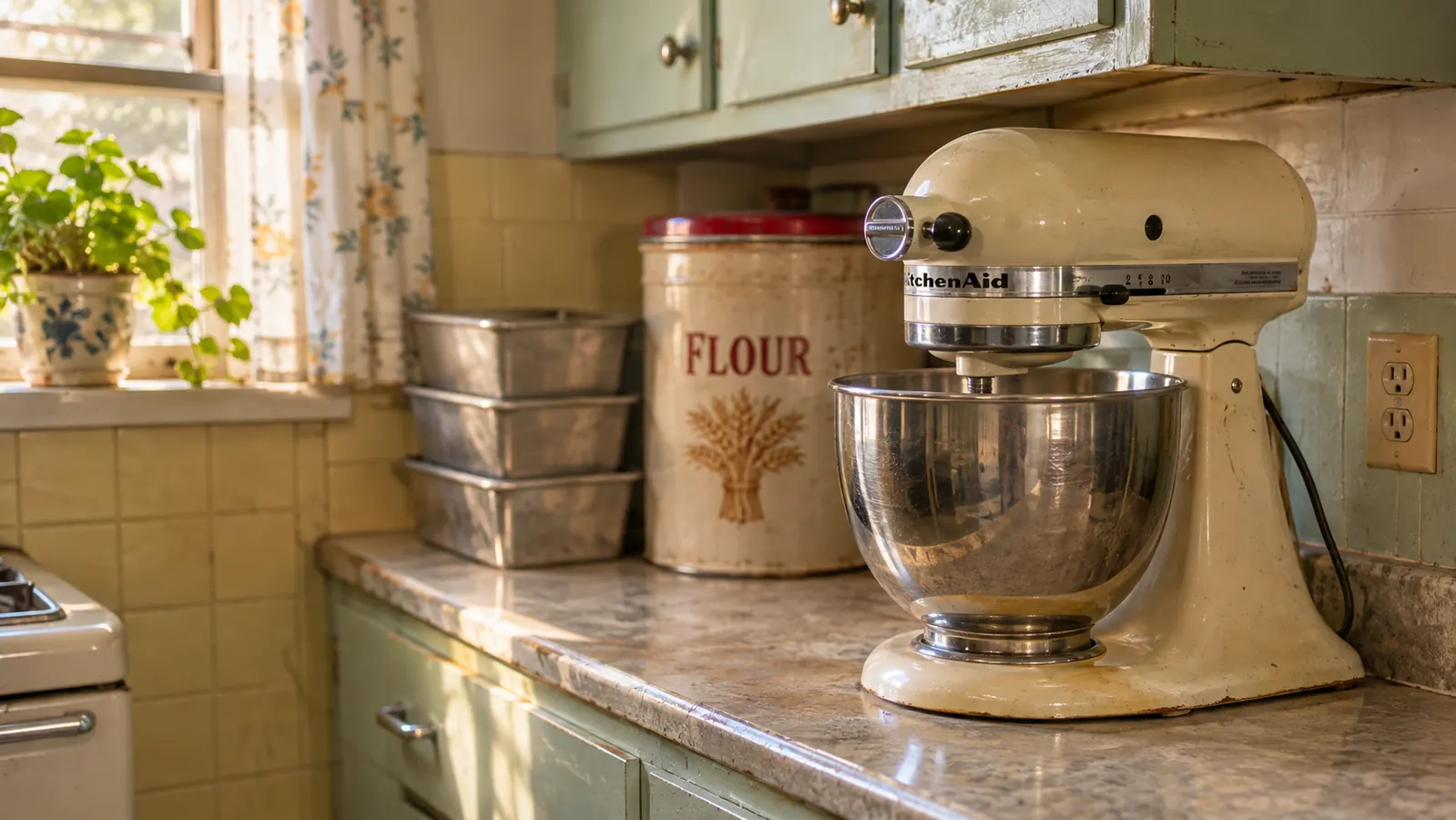
My KitchenAid Artisan has sat on the same nine inches of counter for a year now, and I still have to slide it sideways to reach the flour bin behind it. That is most of what you need to know about owning a stand mixer in a small 1950s kitchen. It is heavy, it earns its footprint, and it will not fix the footprint problem. What it does fix is the thing I spent twenty years blaming myself for: bread dough that never came together the same way twice, buttercream that broke at the worst possible moment, and a hand mixer that smelled faintly of hot plastic every November when the church bake sale came around.
I bought it in late September, a week before I started testing pie dough for the fall sale, and I have used it most weekends since. Sandwich bread on Saturdays. Cookies when Dale asks. Layer cakes for birthdays and one regrettable rye experiment I will not be repeating. I weigh my ingredients, and I have since the year I traced a run of flat cakes to a cheap pan and a guessed cup of flour. What follows is a year of that, written down, including the parts that annoyed me.
The Quick Verdict
A capable five-quart mixer that made my weekend baking repeatable for the first time in thirty years. It also wants counter space you may not have, and it will not apologize for that.
Amazon Check Today's Price →The appliance that survived a year of my Sunday mornings
Ten speeds, a five-quart bowl that twists out for scraping, and a head that tilts back out of the way so you can work. See today's price on Amazon.
Amazon Check Today's Price on Amazon →How I've Used It
The honest version of the year: about forty loaves of sandwich bread, six batches of cookies through the holidays, four layer cakes, two trays of cinnamon rolls I am still proud of, and enough buttercream to frost a small car. I did not use it for anything clever. I used it for the same four jobs, week after week, which is how most people use a stand mixer and how a review ought to be written. Nobody needs a twelve-step technique. They need to know whether the thing does the four jobs it was bought for.
The pattern that emerged is not about the mixer being remarkable. It is about the mixer being the same every time. My hand mixer had two speeds that mattered and a third that whined. When I creamed butter and sugar with it, I got whatever I got and could not tell you why one tray of cookies spread and the next did not. With the KitchenAid set to one speed and left running for a set number of minutes, the variable disappeared. That is a small thing to be pleased about at sixty-one. I am pleased about it anyway.
One more thing surprised me. The machine is at its best when I leave it alone. For the first month I stood over it, nudging the speed up and down the way I used to with a hand mixer, and the results were no better than before. Once I picked a speed, set a timer on the stove and walked away to grease pans, everything got more consistent. The tool rewards a little patience and punishes hovering.
Cleaning is the part the listing does not dwell on. The bowl twists out, which matters more than I expected, because I can carry it to the sink instead of wiping around a machine that weighs twenty-two pounds. The body gets a damp cloth and nothing more. I have never once wished it were lighter, and I have wished it were narrower at least a dozen times.
What Ten Speeds Actually Change
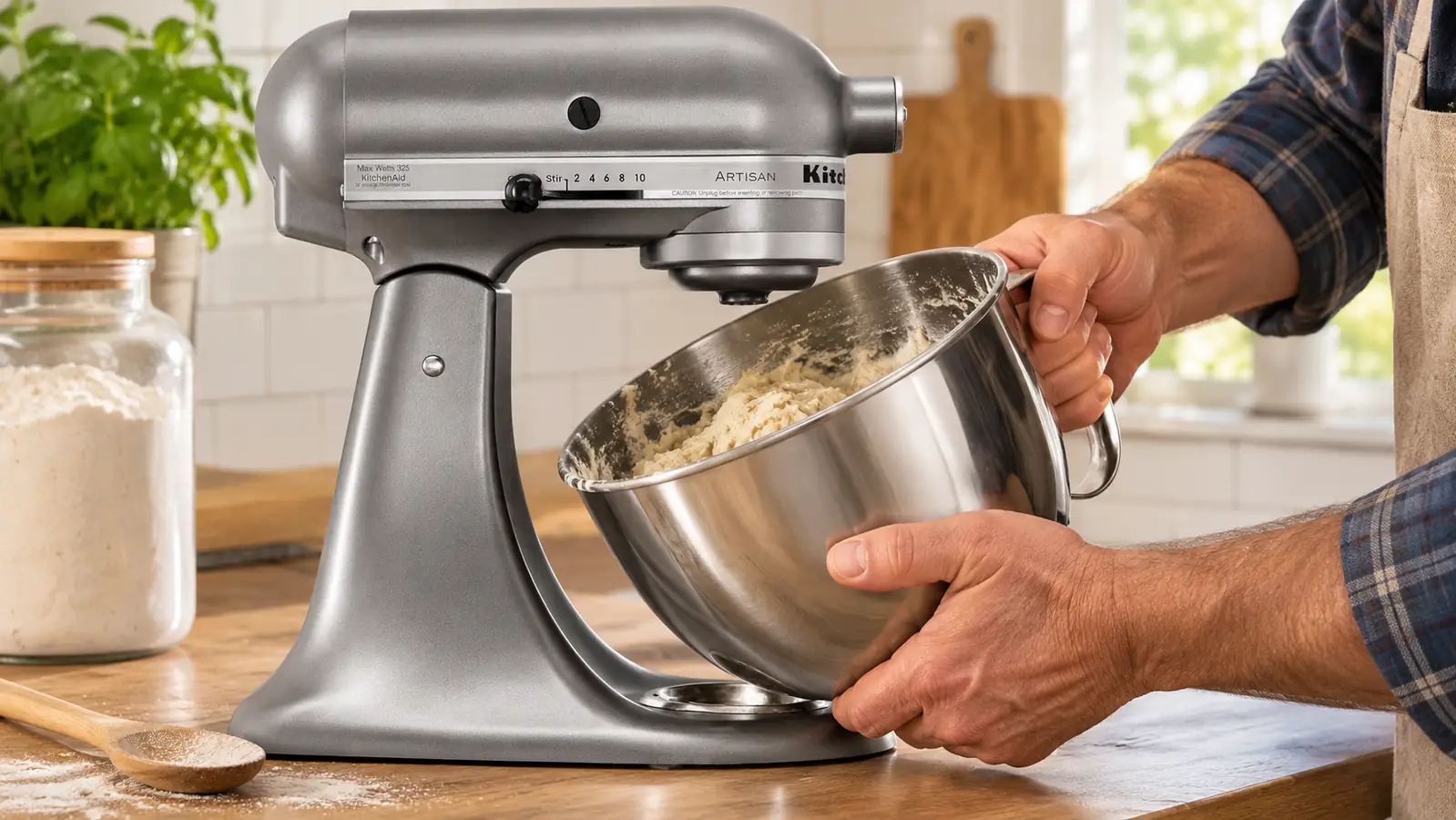
Ten speeds sounds like a number a catalog writer invented. In practice, three or four of them do nearly all the work and the rest exist for the edges. The slowest setting stirs without throwing flour across the counter, which is the whole reason I stopped making bread in a bowl with a wooden spoon. The middle speeds handle creaming and cake batter. The top end is for whipping cream, and it gets there faster than I expect every single time. If you bake with any regularity you will find the two or three settings you trust and use them the way you use the same burner on the stove.
The 325-watt motor is not the biggest number on the shelf and I want to be plain about that. It has never struggled with dough for two loaves, which is the heaviest thing I ask of it. If you routinely make four loaves at once, or bake for a farmers market, you are shopping in a different category and this is not it. For two people and a bake sale every October, it has not once slowed down in a way I noticed.
The control itself is a lever that slides through the ten settings, and it holds where you put it. That sounds like nothing. It is not nothing. The hand mixer I retired had a slider that drifted down a notch when the batter got thick, and I did not notice for years that my creaming time was quietly getting shorter every batch.
Living With It on a Small Counter
The measurements matter more than I expected. The KitchenAid is about fourteen inches deep, nine inches wide and fourteen inches tall, and the head needs room to tilt back, so the practical footprint is bigger than the footprint. Mine sits under the upper cabinet with roughly an inch to spare, and I have to pull it forward before I raise the head. Measure that clearance before you order. I did not, and I got lucky.
Weight is the other half of the same problem. Twenty-two pounds does not sound like much until you are lifting it in and out of a cabinet twice a week. I tried storing it, for about three weeks, and gave up. It lives on the counter now, which is why the flour bin moved. If you cannot give it permanent counter space, be honest with yourself about whether you will haul it out on a Tuesday.
The five-quart bowl is the right size for what I do. A double batch of cookie dough fills it about two-thirds, which leaves room to work. A standard two-layer cake is comfortable. One small batch of buttercream is not, and I will come back to that.
Bread, Cookies, and Layer Cakes: A Year of Sundays
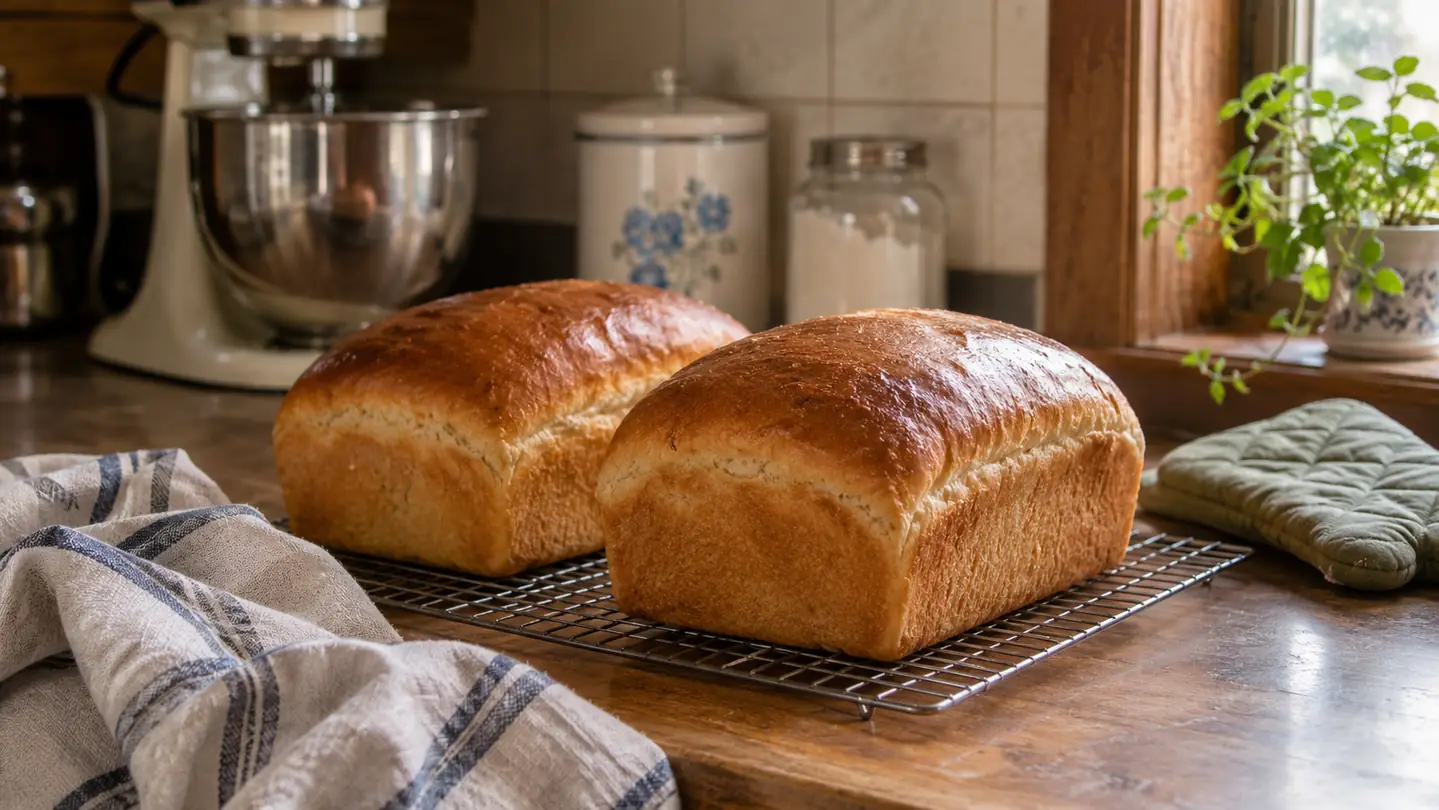
Bread is the test I care about. Two loaves of sandwich bread, roughly 900 grams of flour total, and the mixer works the dough without walking across the counter or warming up in a way I can feel through the bowl. The dough comes out smooth at about the eight-minute mark in my kitchen, which runs hot, so your timing will differ. What I like is that the timing repeats. I write it down, and next Saturday it is the same.
Cookies and cakes are easier and less interesting. The cookies come out even, which they did not with the hand mixer, and I think that is about consistent creaming more than anything else. The cakes rise level. I have stopped standing over the bowl the way I used to, and that is worth something on a Saturday morning when there is also bread to shape and a sink full of pans.
The buttercream is the one place the bowl size shows. A single small batch does not quite fill the bottom, so more of it climbs the sides than gets worked, and I scrape down twice as often as the recipe says. It still comes out smooth. It just takes longer than a smaller bowl would, and it is the kind of thing that only becomes visible after a few months of doing it.
Forty loaves later, the thing I actually bought was repeatability. Same speed, same eight minutes, same dough. That is not a small thing when you have spent thirty years guessing.
Where It Stumbles
It is not quiet. Nobody puts that in the listing and I wish they would. On the upper speeds it has a steady low whine that carries into the next room, and Dale has learned to leave the kitchen when the whipping starts. It is not unpleasant, exactly. It is simply present, for as long as you are whipping, and in a small house you will hear it from the living room.
The warranty is the other thing I would flag. One year of coverage is thin for a machine built to run for a decade, and it is better to know that before you buy than after. Mine has needed nothing in twelve months. A neighbor with an older model needed service in year four, and that is the sort of story that stays with you when you are deciding.
And the head clearance is a genuine trap in an old kitchen. I have an inch, and an inch is not margin. If your cabinets are low, or you have a shelf over the counter, the machine will fit and still not work, because you will not be able to tilt the head back without dragging it forward first. Every time. Twice a week. For a year.
What I Liked
- Repeatable results: the same speed and the same time give the same dough every weekend
- Ten speeds with a genuinely slow stir that does not fling flour across the counter
- The bowl twists out, so washing up is a thirty-second job instead of a wipe-around
- Works two loaves of bread dough without slowing down or walking across the counter
- Five quarts is the right size for standard layer cakes and double batches of cookies
Where It Falls Short
- Twenty-two pounds, and it wants permanent counter space it may not get
- The head needs vertical clearance to tilt back, which low cabinets will not allow
- Loud on the upper speeds, in a way that carries through the house
- One year of warranty coverage is thin for a machine of this size
- The five-quart bowl is oversized for one small batch of frosting
What I Considered Instead
I looked at two other machines before I bought this one and I want to be fair to them. The bowl-lift style with the larger motor is the sensible choice if bread is most of what you bake and you have the counter for it, but it is taller and heavier and it would not have fit under my cabinets. The cheaper tilt-head models trade the metal body for plastic and give up a few speeds, and I have watched a friend go through two motors in five years. I wanted the metal body, the ten speeds and the five-quart bowl, and I did not want to think about it again for a decade.
Who This Is For
This is for the person who bakes most weekends and has been making do. If you are creaming butter with a hand mixer that bogs down, or kneading by hand and enjoying it a little less each year, the Artisan takes that friction out. It is also for the baker who wants repeatability more than power, someone who will write down a speed and a time and use them again next Saturday. If you have a clear stretch of counter and you measure your cabinets first, you will be pleased with it.
It suits a household of two to four people. Two loaves, one cake, a double batch of cookies. That is the range where five quarts feels exactly right and the motor never has to prove anything.
Who Should Skip It
Skip it if you bake twice a year, because twenty-two pounds of machine will spend the other 363 days in your way. Skip it if your counter is already contested, or if your cabinets are low enough that the head cannot tilt back without the machine being pulled forward first. Skip it if you regularly make four loaves at once or sell what you bake, because you need more motor and a larger bowl. And skip it if one year of warranty on a machine this substantial bothers you. It bothered me. I bought it anyway, and I would again.
A year in, I would buy it again, and I would measure my cabinets first this time. What I got for my trouble was not a better baker. I am the same baker. What I got was a Saturday morning where the dough behaves the way it did last Saturday, which turns out to be the thing I was chasing all those years I blamed my own hands.
If your hand mixer has started to smell like hot plastic, this is the upgrade
Five quarts, ten speeds, 325 watts, and a head that tilts back so you can scrape the bowl down without moving the machine. See today's price on Amazon.
Amazon Check Today's Price on Amazon →