
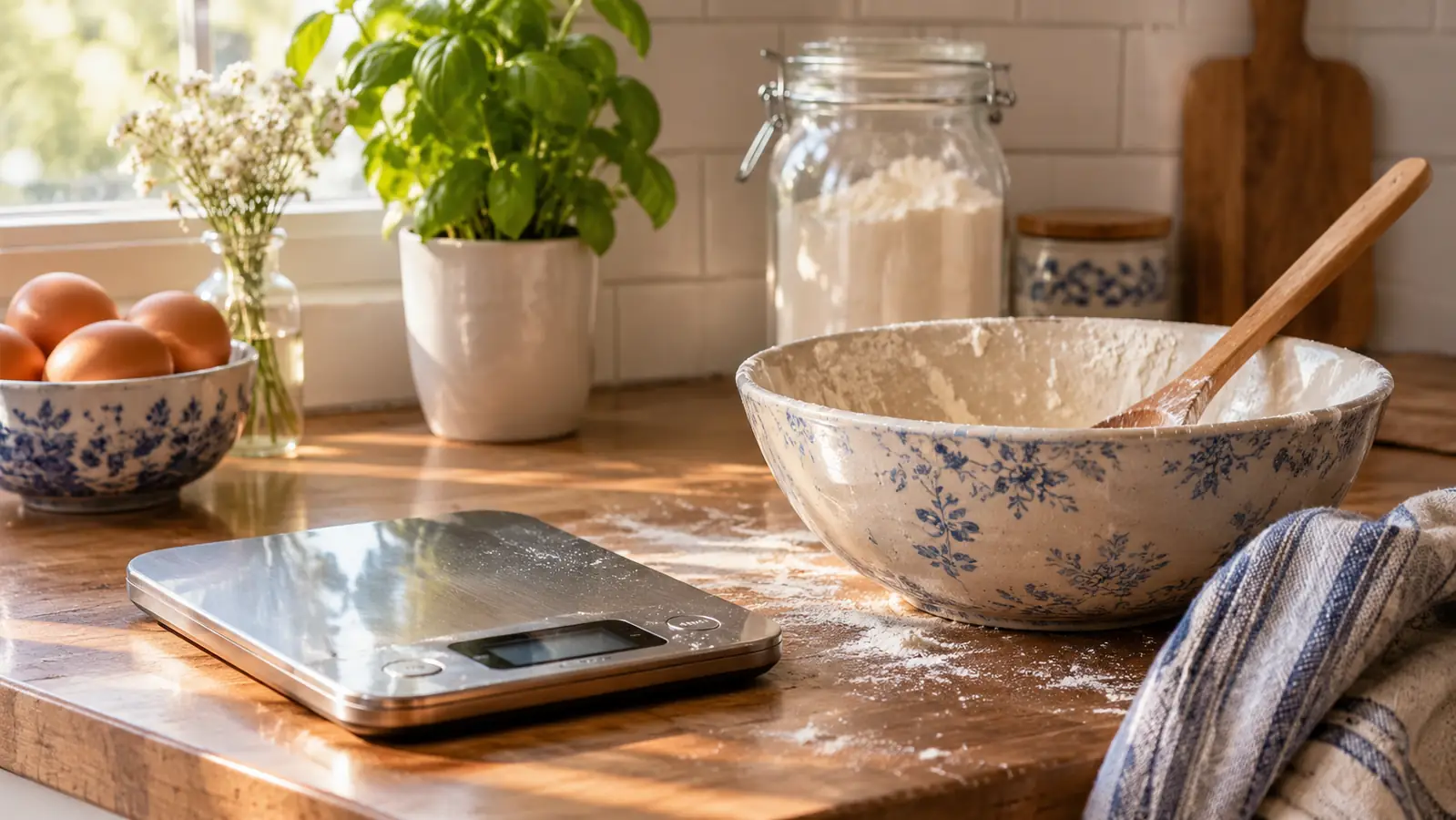
For twenty years I scooped flour out of the bin with a measuring cup and hoped for the best. Some Saturdays the sandwich bread came out tight and dry. Other Saturdays it came out slack and spread across the pan. I blamed the oven first, then the yeast, then myself, and then I bought more yeast and carried on. In February I cleared a strip of counter beside the flour bin, set an Etekcity digital kitchen scale on it, and started weighing instead of scooping. The bread stopped being a coin flip.
I want to be plain about what that does and does not mean. A scale does not know when dough has been kneaded enough. It cannot tell you that the gas oven in my 1950s kitchen runs about fifteen degrees hot, or that the butter was too warm for the pie crust you had in mind. What the Etekcity does is take one variable out of my hands, the one I could never check by eye, so that when a bake goes wrong I am not standing at the counter wondering whether the problem was the flour or the oven or me. Dale has eaten every one of these experiments and will tell me the truth about them. He says the bread has been more consistent since February. He also says the pie crust has not, and he is right, because pie crust was never a measurement problem.
The Quick Verdict
Weighs flour, butter and water to the gram, tucks into a drawer between bakes, and mostly stopped making me think about measurements at all. The coarseness at very small weights is the one thing I still notice.
Amazon Check Today's Price →Weigh the flour once and the guessing stops
Five units, a tare button that resets between ingredients, and a one-gram readout that stays put in your routine. Two AAA batteries come in the box.
Amazon Check Today's Price on Amazon →How I've Used It
The scale lives on the counter through the weekend and goes into the drawer on Sunday night. In a 1950s kitchen where the counter is roughly the size of a card table, that matters. It is small enough that it does not fight the stand mixer for space, light enough that I can move it with one hand while holding a bowl in the other, and plain enough that it does not draw the eye when I am not using it.
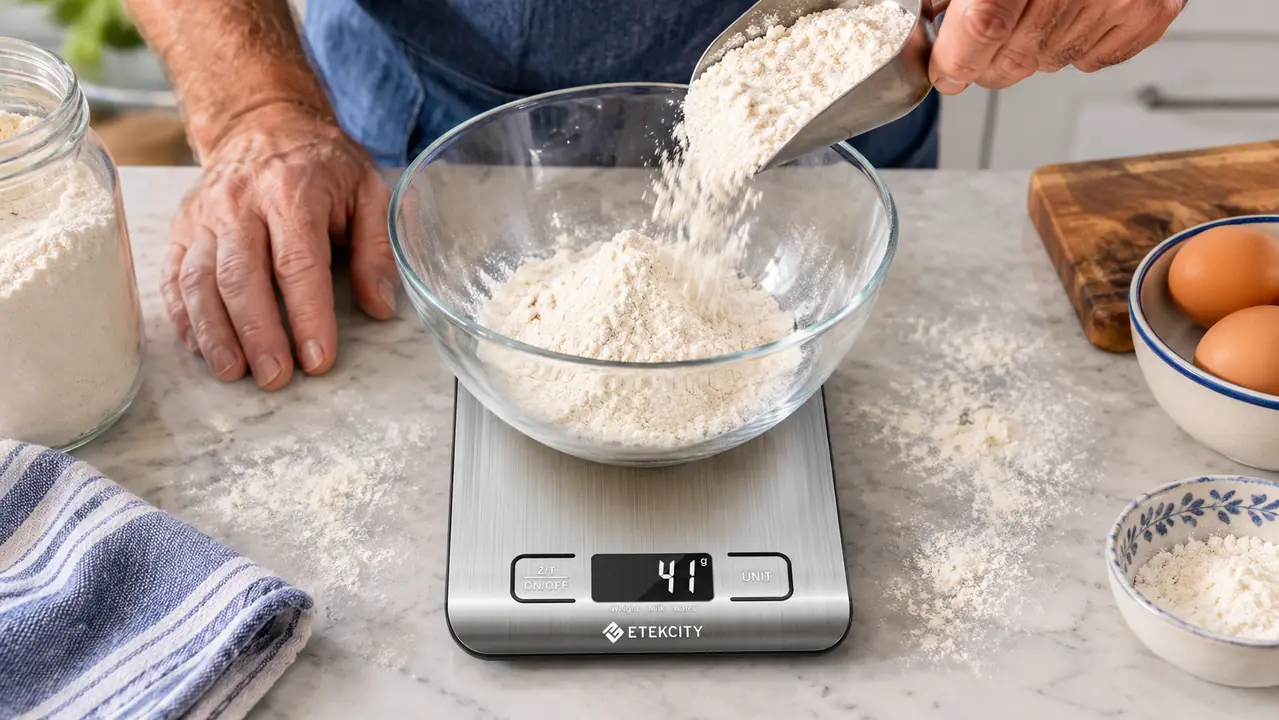
Saturday is bread. Five hundred grams of flour, weighed into a bowl that sits on the platform, then the tare button, then water, then tare again, then salt. One bowl, one scale, three weights, no measuring cups to wash. I used to think of the tare button as a feature for people who weigh meat. Now it is the button I press most in my kitchen, because it turns the scale into a running total that never loses its place. The whole routine takes about ninety seconds. I set the bowl down, wait for the number to settle, add flour until it reads 500, press tare, pour water to 325, press tare, and spoon in the salt to 10. The scale counts the flour and then politely forgets it, which is a small thing that saves a second bowl. Before February I used a two-cup measure and a knife to level it, and I was still never sure the scoop from the bottom of the bin matched the scoop from the top.
The rest of the week the scale gets used in smaller ways. Butter for cookies, in grams, because the wrapper markings never quite line up with what a recipe wants. Thirty grams of dough per cookie so the batch comes out even, which matters more for the church bake sale in October than for a Tuesday. Cocoa for a layer cake. Walnuts for the top of a coffee cake. The cheese for a quiche, which I used to grate by feel and now weigh, because Dale likes it the same every time and I have decided he can have that.
Scaling a recipe up or down is the other thing the scale made simple. Halving a bread recipe means halving five hundred grams of flour to two hundred fifty, which is a number I can work out on a scrap of paper in five seconds. Halving a cup and a third is a fraction problem I used to solve with a pencil and a bad attitude. Last Thanksgiving I made three times my usual pie dough and it came out right the first time, which had never happened in this kitchen before.
Grams, Ounces, Pounds and the Tare Button
The scale reads in five measurements: grams, ounces, pounds and ounces together, fluid ounces, and milliliters. I use grams nearly all the time, and I suspect anyone who buys it for baking will do the same, because the bread books and the pastry books I trust all give weights in grams. The other four settings are not decoration, though. I use the pounds-and-ounces setting for things that are not going into a recipe, a parcel for the post office or a bag of flour when I want to know how much is left. I have used the ounce setting exactly once, to check a recipe my mother wrote on an index card in 1974. Switching units is a single button press and the display changes at once, with nothing to re-enter. I move to pounds and ounces maybe once a week, then back to grams without thinking about it. The buttons sit together on the same panel, and after a few weeks my thumb found all three without my looking, which is the highest compliment I can pay a kitchen appliance.
Fluid ounces and milliliters are for liquids, and here is the honest caveat. The milliliter setting assumes you are weighing water. A cup of water really is close to 237 milliliters. A cup of honey is not, and the scale has no way to know that, so for honey, molasses and syrup I stay in grams and use a conversion I trust. If you take one thing from this review, take that: mL on a kitchen scale is a water measurement wearing a general-purpose label.
The readout is a backlit LCD with large numbers. That sounds like a line from the box, and it is, but it earns its place when you are sixty-one and reading it under a forty-watt bulb. I can see it from a step back with a bowl in my arms. The platform is 304 food-grade stainless steel and wipes clean with a damp cloth. That is the whole cleaning procedure. Nothing comes apart, nothing gets lost in the sink.
What One Gram of Accuracy Actually Changes
The scale reads to one gram and holds up to eleven pounds. One gram is fine enough for everything I bake in quantity: flour, sugar, butter, water, milk, dough portions. It is not fine enough for the small things. Two grams of yeast and three grams of salt both sit at the bottom of what a one-gram scale can resolve, and the difference between two grams of salt and four is something you can taste in a loaf. For yeast and salt and spices I still use measuring spoons, and I have stopped asking the scale to do a job it was not built to do.
Where the one gram earns its keep is in the ranges where a scoop and a scale disagree badly. A cup of all-purpose flour scooped straight from the bin runs anywhere from about 120 grams to about 150, depending on how packed it is and how deep the cup went. Thirty grams is a sixth of a cup. A sixth of a cup is the difference between dough that rises into the pan and dough that slumps against the side of it. Weighed at 125 grams, the flour is the same flour every Saturday, and the dough behaves like the same dough. I measured the old way once, out of curiosity: dip the cup into the bin, shake it level, weigh it. It came to 148 grams. The next cup, scooped from the same bin with a lighter hand, came to 131. Neither was wrong, both went into the same loaf for twenty years, and that is exactly the range that made my bread a coin flip.
The eleven-pound capacity means I can set a whole chicken on it, or a bowl of dough for a double batch, without running out of range. I have weighed a five-pound bag of flour in the bag to see whether it was short. It was not, and the scale did not hesitate.
In March I made a batch of rolls that came out heavy and close-textured. Before the scale I would have shrugged, blamed the yeast and bought new yeast. This time I knew the flour had been weighed at 125 grams a cup and the water had been weighed too, so the problem had to be somewhere else, and it was: I let the dough over-proof while I was on the telephone. That is what a scale is actually good for. It tells you where the problem is not.
None of that fixes my oven, which runs hot and which I have learned to correct for with a thermometer and a half-turn of the pan. Two loaves from the same weighed dough can still come out uneven if I forget to turn them. The scale narrows the variables down to the ones I can actually watch. It does not take me out of the equation.
Over Several Months: What Held Up and What I'd Change
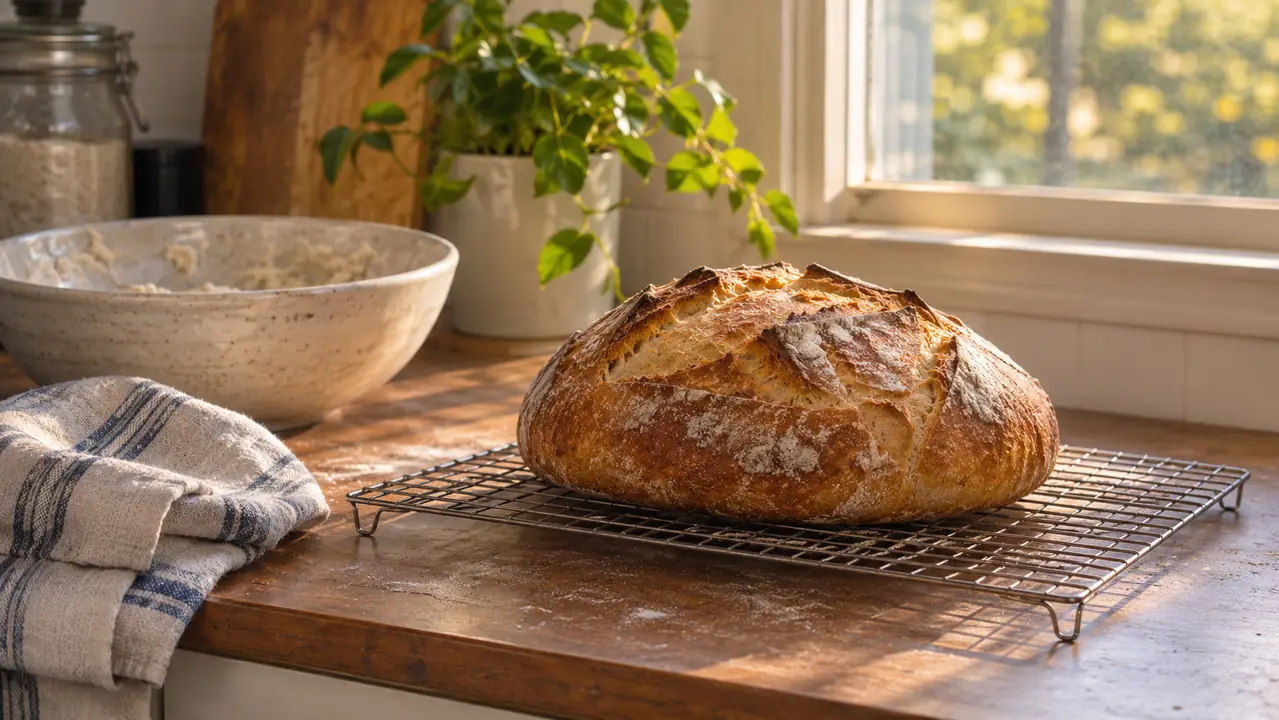
The stainless platform has taken spilled milk, a dropped spoon, an overturned cup of cocoa and a great deal of flour, and it looks the way it did in February. The two AAA batteries that came in the box are still the ones in it. I have checked the readings twice against a five-pound bag of sugar labeled by weight, and both times it was right on. The second check was in June, after four months of weekend use, and the Etekcity read the same as it had in February. I have also weighed a stick of butter straight from the wrapper, which the label calls four ounces, and got 113 grams, which is four ounces to the gram.
What I would change is short and honest. One gram is coarse at the bottom of the range, and there is no way around that at this size. The milliliter setting only holds true for water. When I set my widest mixing bowl on the platform it hangs over the front edge, so I have learned to set it back a little to keep the numbers visible. And the stainless surface shows every fingerprint and every dusting of flour, so if a spotless-looking scale matters to you, know that this one will look used within a week. The platform also holds a faint ring where the mixing bowl sits, and a dry cloth alone will not lift it. A rag with warm water and a drop of dish soap does, then I dry it, and the ring returns the next Saturday. It is cosmetic and does not affect a reading, but if you like equipment that looks new, this is not that scale.
The surprise is how fast the scale stopped being a gadget and became part of the routine. I bought it expecting to use it for bread and to forget about it. Instead it comes out four or five times a week, for a portion of dough, for the butter in a crumb topping, for the cheese in a quiche, for a bag of chocolate chips that claimed twelve ounces and weighed eleven and a half.
What I Liked
- Tare resets between ingredients, so one bowl does most of the work
- Five measurements including grams, pounds and ounces, fluid ounces and milliliters
- One-gram readout and eleven-pound capacity cover flour, butter, water and a whole chicken
- Backlit LCD with large numbers, readable from a step back
- Stainless platform wipes clean with a damp cloth, nothing to take apart
- Small enough to live in a drawer between bakes
- Batteries are included and the originals are still going
Where It Falls Short
- One gram is too coarse for salt, yeast and spices, so spoons still have a job
- The milliliter setting is only honest for water
- A wide mixing bowl overhangs the platform and can crowd the numbers
- The stainless surface shows every fingerprint and every dusting of flour
Before the scale I would have blamed the yeast. Now I know the flour and the water were right, so the problem is somewhere I can actually look.
Who This Is For
This is for the home baker who makes the same dozen recipes over and over and wants them to land the same way each time. It suits anyone who halves or doubles recipes and has ever stood over a measuring cup doing arithmetic. It suits a small kitchen, because the thing stores in a drawer and weighs almost nothing. If you bake bread most weekends, or you sell at a church bake sale every fall, or you are simply tired of scooping flour and guessing, the Etekcity earns its strip of counter. It is also a reasonable first scale for someone who has never weighed an ingredient and wants to find out what the fuss is about without committing to a laboratory instrument.
Who Should Skip It
Skip it if you bake once a year from a boxed mix, because a scale will not change anything you do. Skip it if the real problem is your oven, since no scale corrects a hot oven and mine still runs fifteen degrees high. Skip it if you need tenth-gram precision for yeast, curing salts or anything outside the kitchen, because one gram is as fine as this reads. Skip it if the milliliter setting is the reason you are buying, because it only tells the truth about water. And skip it if you want a scale with features beyond weighing. This one weighs, switches units, tares and gets out of the way, and that is the whole of it.
Nine Saturdays of the same loaf is the entire pitch
It is not a gadget that will make you a pastry chef. It is the thing that removes one variable from your Saturday morning, and it does that every time.
Amazon Check Today's Price on Amazon →