
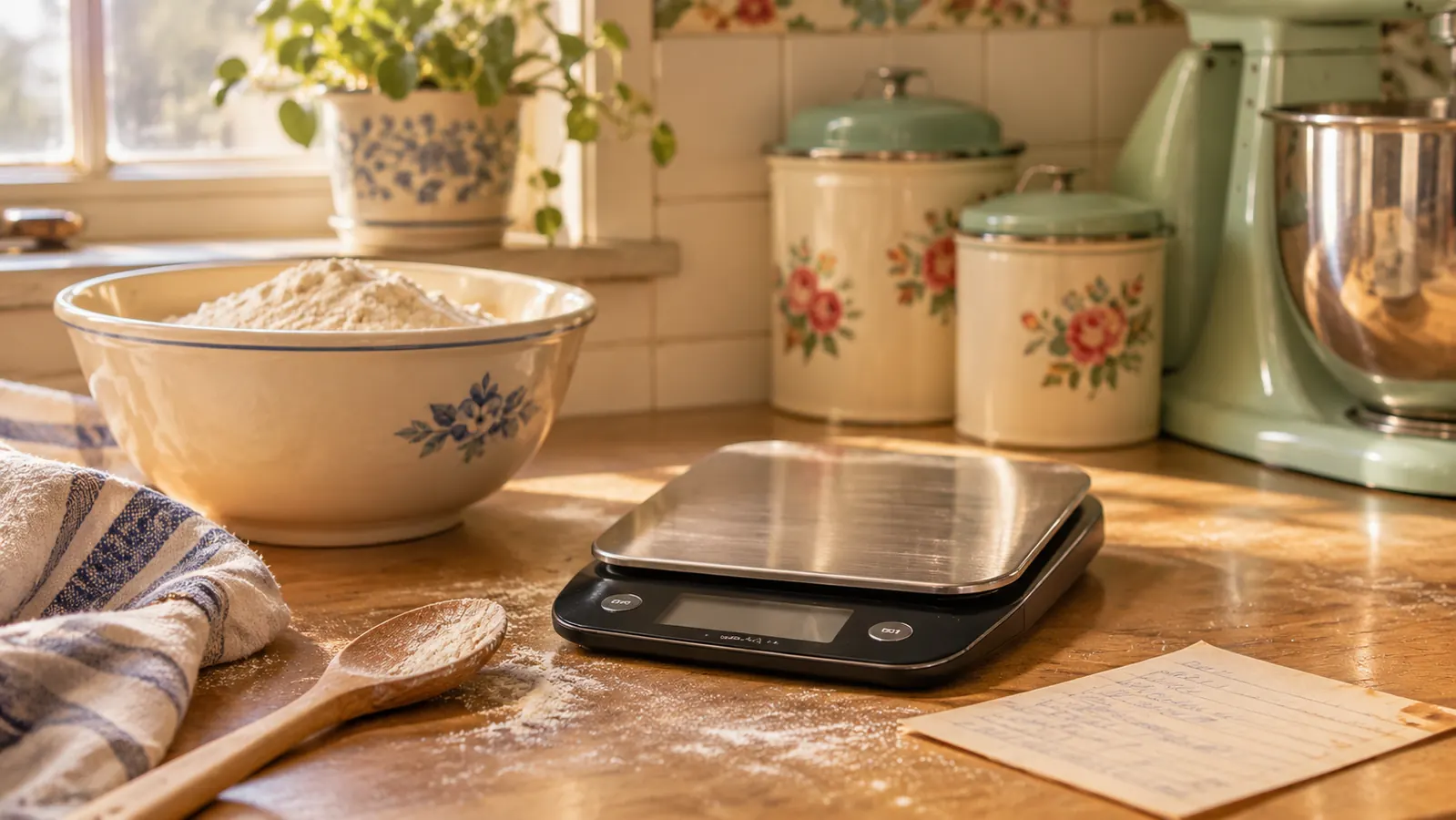
Short answer: for most home baking, the Etekcity food scale does what the recipe asks and takes up less room doing it. The OXO Good Grips is the better tool in one specific situation, and if you have never run into that situation, you will not miss it.
I keep both on the counter in Lancaster, which is more counter than my 1950s galley kitchen can spare. I have weighed the same bowl of flour on each one more times than is reasonable. I have baked most weekends for thirty years, so I know what my own bad habits cost me, and my gas oven runs about fifteen degrees hot. My usable work space is roughly two feet wide between the sink and the cutting board, which means any tool that has to be moved before I can set down a mixing bowl starts the morning at a disadvantage. Here is what the difference between the Etekcity and the OXO looks like when your hands are already covered in flour.
| Etekcity | OXO Good Grips | |
|---|---|---|
| Capacity | 11 lb / 5 kg | 11 lb |
| Readout | 1 g increments | 1 g and 0.1 oz |
| Reading with a wide bowl on the platform | Fixed screen at the front of the platform; a wide bowl can sit over it | Display pulls out clear of the bowl |
| Footprint | Mini form factor at 200 g; stores in a drawer | Wider platform; wants counter or shelf space |
| Units | oz, lb:oz, fl oz, g, mL | g, oz, lb/oz |
| Tare | Tare function for zeroing a bowl | Tare function for zeroing a bowl |
| Cleaning | Wipe the 304 food-grade stainless surface | Wipe down a larger platform |
| Feel on the counter | Light; can shift when a loaded bowl is set down hard | Sits heavier and stays put |
| Best for | Small batches, drawer storage, recipes written in mL | Double batches and wide mixing bowls |
How I Compared Them
Three weeks, the same recipes, both scales side by side on the same two feet of counter. I started on a Saturday in January with the sandwich bread I make every week, and worked through cookies, a gingerbread, and two pies before the three weeks were up. I weighed flour, sugar, butter, milk and yeast in grams, wrote down the number each scale gave me, and noted the things that are easy to forget by the time you are washing up: whether I could read the display with the bowl still on, whether the scale slid when I set the bowl down, and whether I had to lift the bowl to see anything at all. Dale, who is retired from machining and has firm opinions about anything with a tolerance, did the tasting.
Both scales were zeroed with the bowl on the platform every time, so the tare function was not the variable. Same bowl, same flour, same scoop. What I was watching for was not which scale was more accurate, because on a kitchen counter in a normal kitchen they agree closely enough that I could not tell you which one was right and which one was a gram off. The two of them matched on every single weigh-in across those three weeks, which surprised me less by the end than it did on the first Saturday. What I was watching for was which one I reached for without thinking about it, and how many times a morning I had to stop and peer at a number.
Where the Etekcity Wins
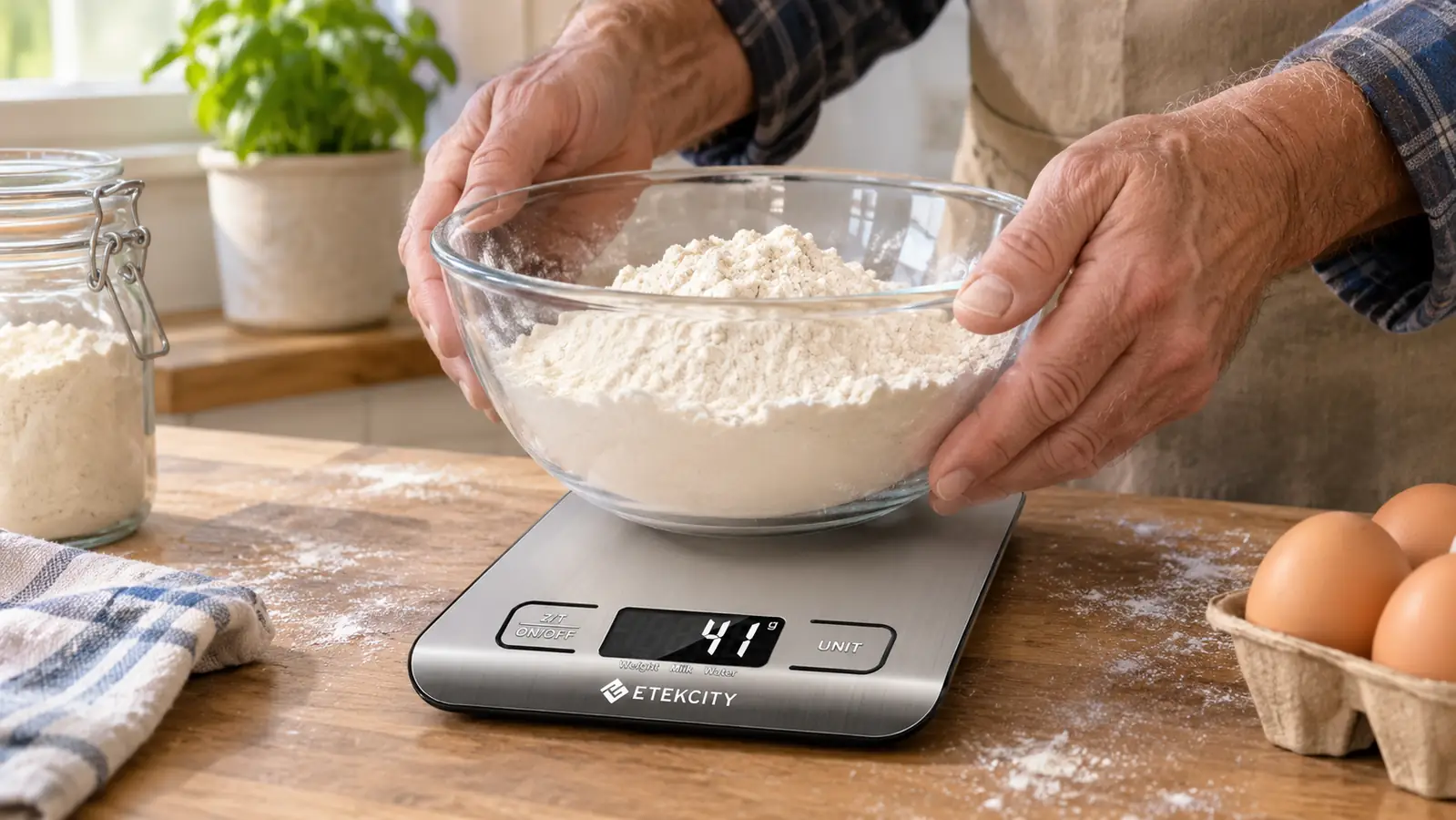
Mini is the word the listing uses and it is the honest one. At 200 g the scale is light enough to live in the drawer with the measuring cups and small enough that I can leave it out between the cutting board and the sink without giving up work space. In a kitchen this size that is not a small thing. A scale that has to be fetched from another room is a scale that gets skipped on the days you are in a hurry, and skipped weighing is how a recipe quietly stops being repeatable. I tested that on myself in the first week: I put the OXO on the shelf above the mixer to see whether I would climb for it on a weekday morning. I did not. I used cups twice and the bread came out two days denser the second time.
It also reads in five units, and two of them I use more than I expected: milliliters and fluid ounces. Milk, water, honey and oil all go in by weight now, which means one bowl and no measuring cup to wash afterward. The range is 11 lb or 5 kg with 1 g increments, which covers a single loaf, a double batch of cookie dough, and the occasional parcel I want to weigh before I mail it. The fluid ounce setting is the one that earned its keep in a hurry, because the pie dough recipe I use calls for ice water in tablespoons and I had been converting badly for years.
The unglamorous parts are the ones I notice every week. Two AAA batteries come pre-installed, so it works the minute it comes out of the box, and I have not had to change them yet. The backlit LCD has large enough fonts that I can read it at sixty-one without putting my glasses on, which matters more at seven in the morning than I would have guessed. The platform is 304 food-grade stainless steel, which means a wipe with a damp cloth and it is done, and a dusting of flour does not turn into a paste in the corners. What it is not is heavy. Set a loaded bowl down hard and the whole scale can shift an inch, and you will zero it again out of habit even when you do not need to.
Where the OXO Good Grips Wins
The display. That is the whole argument, and it is a real one. When you set a wide mixing bowl on the platform of most scales, the bowl covers the screen and you are left lifting it to peek underneath, which is exactly the moment you lose track of what you were adding. The OXO Good Grips pulls its display out from the body so the numbers sit clear of the bowl. If you weigh straight into wide bowls every week, that is worth paying for. The gingerbread batch is where I stopped arguing with myself about it, because the molasses goes in slow and I was reading the number the entire time instead of lifting a bowl off and on.
The platform is wider, and a wider platform is steadier under a big batch. A double batch of bread dough, a full batch of gingerbread, a bowl of sliced apples for a pie, all of it sits better on more surface. I have never tipped a bowl on the Etekcity, but I have come close when the bowl was wider than the platform and I set it down off center, and on the pie day I set the apples down twice before I got them centered.
It also sits heavier on the counter, which sounds like a small thing until you have dragged a loaded bowl across a light scale and watched the whole thing turn. Between the wider platform and the weight, the OXO feels like equipment rather than an accessory. The trade is that it wants counter or shelf space and it costs more, and neither of those is imaginary when your work surface is two feet wide and the drawer is already full. I measured the OXO against the gap between my mixer and the wall and it did not fit there. It ended up on the shelf, which is the shelf the Etekcity never has to visit.
The Scale That Fits Beside the Flour and Stays Out of the Way
11 lb or 5 kg capacity, 1 g increments, five units including milliliters, and two AAA batteries already in the box. The Etekcity sits at 4.6 stars across more than 178,000 ratings from people who mostly wanted a number they could trust.
Amazon Check Today's Price on Amazon →What One Gram Actually Buys You
Both scales read to a single gram, so resolution is not where this decision lives. It lives in whether a single gram matters to what you are making. For yeast, salt, baking powder and instant espresso powder, a gram is a real quantity and one gram either way changes a loaf. For flour, one gram is noise. The difference between a cup of flour scooped from the canister and a cup spooned and leveled can run forty grams, and no display on earth fixes that. I know because I did it: I scooped a cup the way I did for twenty years, weighed it at 168 grams, then spooned and leveled the next one at 128. Forty grams, in my own kitchen, with my own scoop. Weighing fixes that. That is not the same as the scale fixing it.
A cup of flour scooped straight from the canister can swing forty grams. The scale that catches that is the one already sitting on your counter.
So the useful question is not which scale is more accurate. It is which scale you will actually pull out on a Tuesday when you are already running late. I have tested that on myself, repeatedly. The one that lives in the drawer beside the flour gets used. The one on the high shelf gets used when I remember, which is less often than I would like to admit.
The Tare Habit
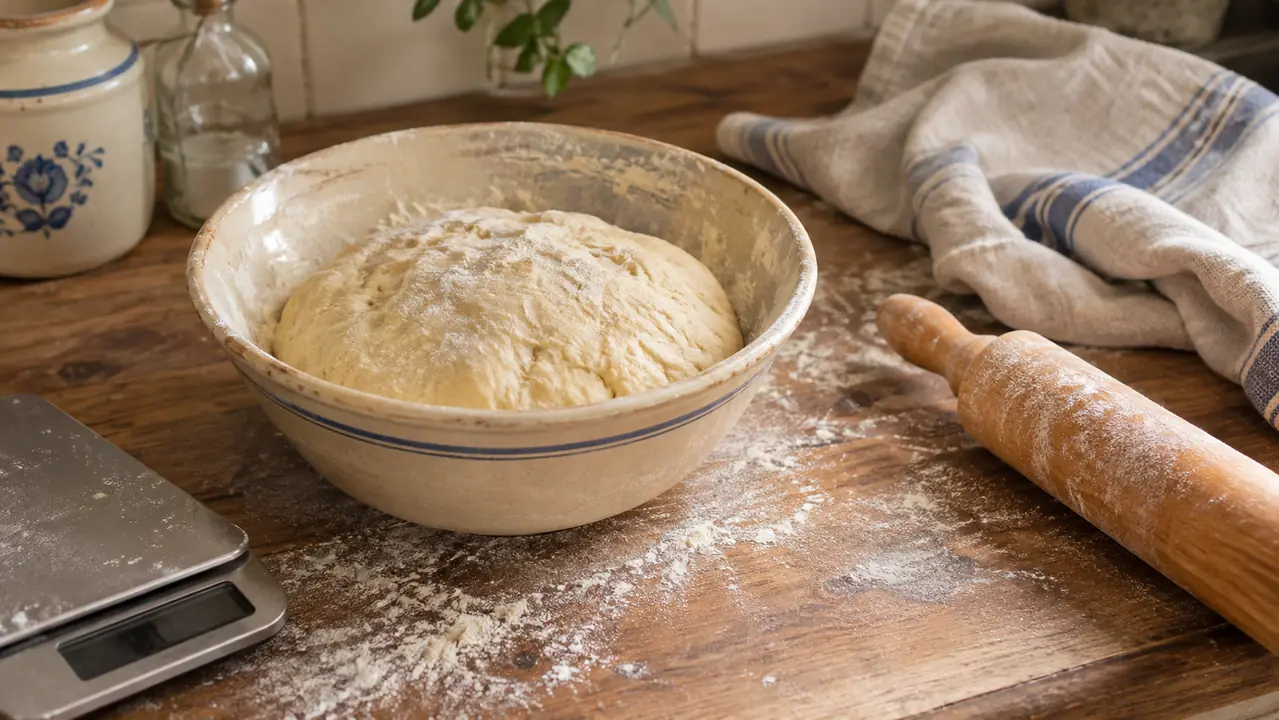
Both scales have a tare function and both zero the bowl without complaint, so the difference is in the habit rather than the feature. My routine is the same on either one: bowl on, zero, flour in, zero again, water in, and by the end I have used one bowl and no cups. What changes is how often I have to stop and look. On the OXO I look at the pulled-out display. On the Etekcity I look at the screen at the front of the platform, which works perfectly well as long as the bowl is smaller than the platform. My everyday mixing bowl is eight inches across and the Etekcity platform is not, so I angle the bowl slightly toward the back edge and the number stays visible.
The other difference is drift. The Etekcity is light enough that a hard set-down can nudge the reading, so I have gotten into the habit of glancing at it after I load the bowl. That is not a defect exactly, and it has never cost me a bake. It is just the sort of thing you notice after a few weeks and adjust to without thinking about it again. The OXO never made me develop that habit, and I will give it that much.
What Neither Scale Fixes
An oven that runs hot, a pan that conducts unevenly, butter that was supposed to be soft and is not. I spent years blaming myself for cakes that domed and cracked before I worked out that my gas oven ran fifteen degrees hot and my old pans had thin bottoms. I bought an oven thermometer in 2019 and found out in one afternoon what a decade of guessing had cost me. A scale does not touch any of that. What it does is take one variable off the table, so that when something goes wrong you are not also guessing about the flour.
That is the honest case for weighing at all: repeatability. If the sandwich bread came out well on Saturday, you can make the same bread next Saturday, because the numbers were the same. It does not make anyone a pastry chef, and neither scale will. It just turns a good bake into something you can do again on purpose.
Who Should Buy Which
Buy the Etekcity if your kitchen is small, if the scale needs to disappear into a drawer, if you weigh in milliliters and fluid ounces as often as grams, or if you are buying a scale to find out whether you even like weighing. It is also the one I would put in a first apartment kitchen, because there is nothing to learn, nothing to store, and nothing precious to break. My own drawer is eleven inches deep and the scale goes in flat beside the cup measures with room to spare.
Buy the OXO Good Grips if you regularly weigh into a wide bowl, if you bake double batches most weekends, or if reading the number from where you stand matters more to you than drawer storage. That is a real preference and I am not going to call it foolish. It is just narrower than the price gap suggests, and most weeks in my kitchen the wider platform is holding a bowl of flour that weighs less than a pound. Dale, who has watched me argue with both of them, put it more simply: he would buy the cheap one and spend the difference on butter.
Start With the Scale You Will Actually Pull Out of the Drawer
1 g increments up to 11 lb, a backlit LCD you can read without your glasses, and a stainless platform that wipes clean in one pass. Batteries included, so Saturday can start in about ten seconds.
Amazon Check Today's Price on Amazon →