
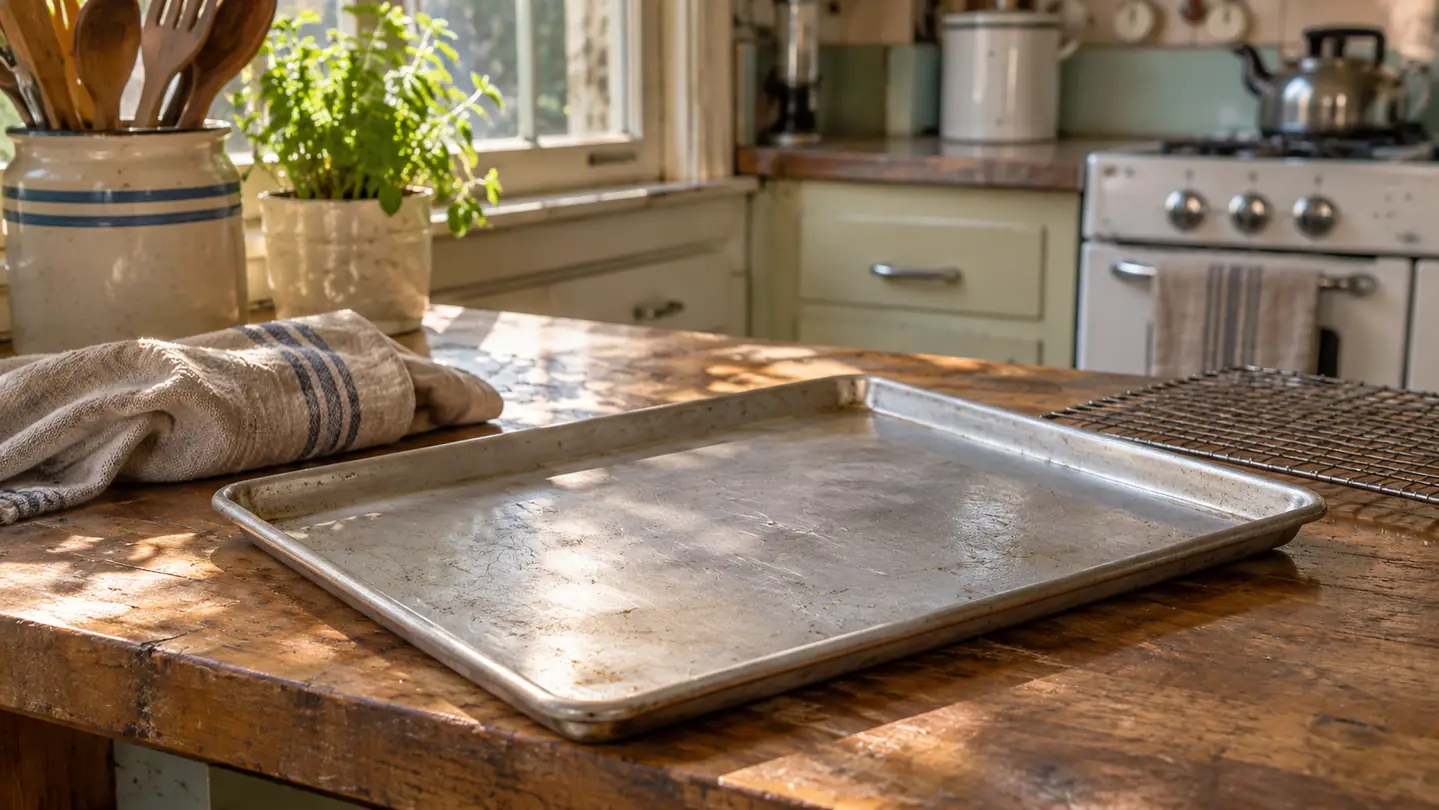
The Nordic Ware Naturals half sheet is the pan I reach for more than any other object in my kitchen, and I want to be clear about that before I say anything critical. It browns cookies evenly. It has never warped on me. It costs less than a single fancy nonstick pan and it will outlast most of them. If you are here to find out whether it is worth buying, the answer is yes, and you can stop reading at the end of this paragraph.
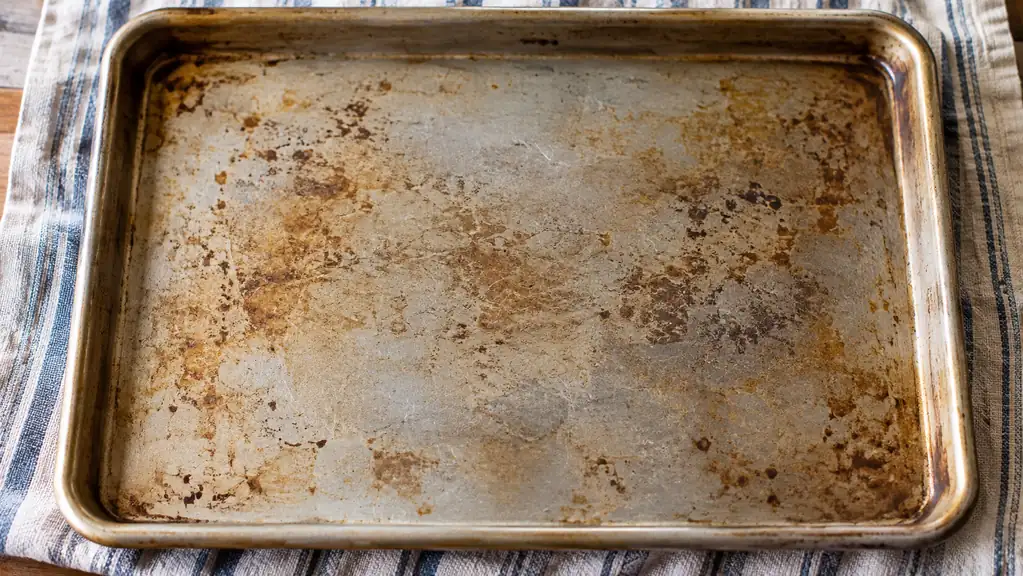
But the reviews do not tell you the whole thing, and I think you deserve the whole thing. This pan will discolor. Permanently. Within a few weeks of regular use it goes from bright silver to a patchy brown, then darker, and no amount of scrubbing brings it back. That is not a defect. It is what bare aluminum does. Nobody warned me and I spent a good hour one Saturday with a scouring pad, certain I had ruined a brand new pan.
The Quick Verdict
An even-browning, non-warping workhorse held back only by cosmetic staining that no cleaner fixes and no brand will tell you about upfront.
Amazon Check Today's Price →The pan I'd buy again, stains and all
Two half sheets, pure aluminum, made to take a beating for years. If you can live with a pan that shows its history, this is the one.
Amazon Check Today's Price on Amazon →What Nobody Tells You Before You Buy
Here is the part I wish had been on the box. Nordic Ware makes these from pure aluminum, uncoated, with no finish of any kind. That is exactly why they conduct heat so well and why they brown so evenly. It is also why they stain. Aluminum oxidizes, and heat accelerates it, and the fats and sugars in what you bake react with the surface. Over months you get a mottled brown map of everything you have ever cooked.
There is a moment, usually around week three, when you notice the first dark blotch near one corner and you assume you did something wrong. You did not. A reader named Gail left a review on a competing pan saying the same thing happened to her and she threw it out, thinking it was rust. Aluminum does not rust. It discolors. Those are different things and the difference matters, because one is a reason to return a pan and the other is a reason to keep using it.
The second thing nobody says plainly: this pan is not nonstick and it is not going to become nonstick. You will need parchment, a silicone mat, or a real greasing. Eggs will stick. A roast chicken will leave fond welded to the pan that needs soaking. If you came from a nonstick sheet and expect the same release, you will be disappointed and you will write an angry review.
How I've Used These Pans
I bake most weekends. Sandwich bread, cookies, a pie now and then, layer cakes for birthdays, and a great deal of sheet-pan dinner because my husband Dale and I are at the age where a tray of roasted vegetables and a piece of fish is a perfectly good supper. I bought the two-pack in the fall and the pans have been in near-constant rotation since. They live stacked in a narrow cabinet beside the oven because my counter space is a joke.
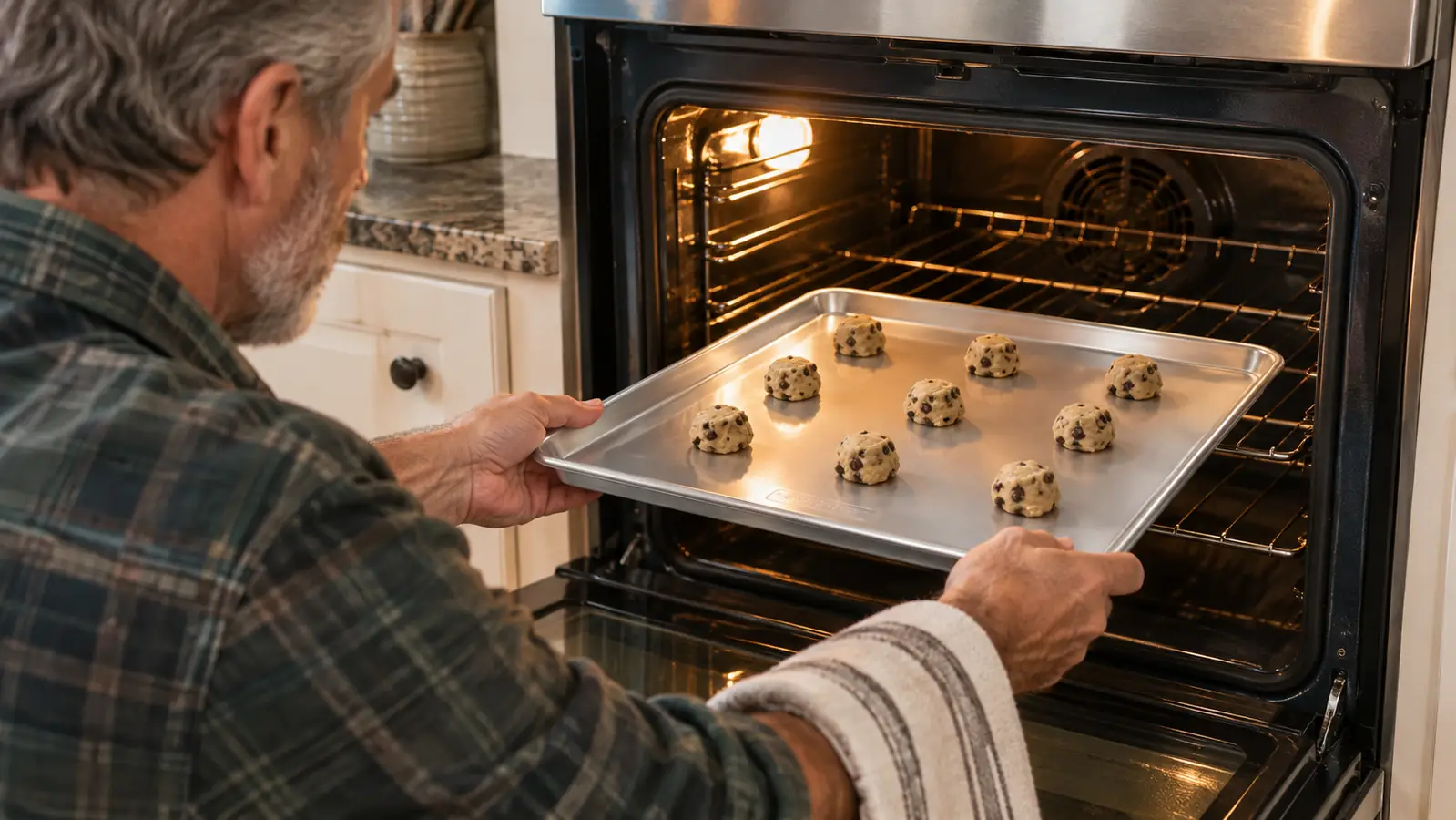
My oven is a gas model from the 1950s that runs about 15 degrees hot. I have a thermometer clipped to the rack and I know the offset, so I account for it. That quirk is why even browning matters so much to me. On my old dark nonstick sheets, the bottoms of cookies would set and darken before the centers caught up, and I was forever pulling trays early and shuffling them around. On these pans, at the same rack position and the same offset, the browning across a tray of chocolate chip cookies comes out close to uniform edge to edge.
The encapsulated galvanized steel rim is the reason. A bare aluminum pan with a plain rolled edge will flex when it hits a hot oven, and that flex is what makes a sheet pan go bang and buckle. Nordic Ware puts a steel rim around the perimeter to hold the shape. I have put these in a 425 degree oven straight from a cool counter more times than I can count, and I have not had a single warp. Not one.
The size is worth stating precisely because it is where people trip. Exterior is 17.9 by 12.9 by 1 inch. Interior is 17.1 by 12.1 by 1 inch. That is a true half sheet, sometimes sold as an 18 by 13. It fits a standard home oven on a normal rack with clearance on all sides. It is larger than the jelly roll pans sold in grocery stores, which catch people out when they try to use a recipe written for the smaller pan and end up with cookies touching.
One Saturday in October I set out to test them side by side properly. I mixed a double batch of oatmeal cookies, the kind with more oats than flour and a great deal of butter, and dropped twelve portions on each pan, same size, same spacing, both on the middle rack, rotated front to back at the ten minute mark. The first tray came out with the edges set and the middles still soft, which is what you want. The second tray went in while the oven was still recovering from the first and came out perhaps half a shade darker around the outer ring, and that was the entire difference. On my old dark pans those two trays would have been two different recipes. I have repeated the test since with biscuits and with a tray of roasted carrots and gotten the same boring result, which is exactly the result I want from a pan.
They have gone into a 425 degree oven straight off a cool counter more times than I can count, and not one has warped.
The Staining Question, Answered Honestly
People ask whether the discoloration affects performance, and the fair answer is no, but it is not quite that simple. A well-seasoned brown surface actually releases baked goods a little better than a brand new bright one. Cookies slide off more easily after six months than they do in week one. That is a genuine upside and it is the same principle behind seasoning a cast iron skillet.
The downside is that the pan stops being something you enjoy looking at. If you bake for the church sale every fall and you photograph your trays, the pan in the background will look like it has been through a war. Mine does. I have made peace with it, mostly. What I will not pretend is that the staining is charming, because it is not. It is just cosmetic and it is unavoidable.
I noticed the first mark in the second week, a pale gold oval near the back left corner where a chicken had roasted the Sunday before. By Thanksgiving the whole pan had a brown cast and the corners were darker still. I went at it with a baking soda paste, which is the internet's answer to everything, and then with a lemon half and coarse salt, which is the internet's other answer. Neither did much beyond making the pan smell better for an afternoon. A friend who runs a restaurant kitchen told me to try a powdered cleanser, and I did, once, and it lightened the surface unevenly so that the pan looked worse than it had before, mottled rather than simply brown. I stopped there and I have not bought a special aluminum cleaner since, because I no longer believe one exists.
One practical note that saves you effort. Do not soak these. Aluminum reacts with strong detergents and with acidic soaking water, and long soaks are what produce the darker, almost black patches rather than the warm brown ones. Wash with hot water, a little dish soap, and a non-abrasive pad, dry it promptly, and put it away. That routine will not prevent all discoloration but it will keep the pan from going dark and blotchy. Skip the dishwasher entirely. Dishwasher detergent is harsh on bare aluminum and will strip and darken it faster than anything you do in the oven.
And do not chase the shine. I tried baking soda paste, I tried lemon, I tried a scouring pad, and the best result I got was a slightly lighter brown patch with a duller finish around it. If a bright silver pan is what you want, buy a coated pan and accept that the coating will scratch instead. There is no version of this where you keep both.
Two pans that will outlast the finish you wanted
Pure aluminum, a steel rim that stops the warp, and a lifetime limited warranty. The discoloration is the trade. Most bakers decide it is worth it.
Amazon See the Two-Pack on Amazon →Where It Falls Short
The limp hand test. Pick up an empty half sheet by one corner with two fingers and it flexes under its own weight. That is the aluminum being thin, and it is the same thinness that makes it heat fast and evenly. The steel rim keeps it flat in the oven but it does not make the pan feel substantial in the hand. If you want a pan that feels like a slab, this is not that pan.
The edges are rolled, not folded sharp, so there is a small lip you can feel. It is fine. It is not a flaw. But if you have ever slid a spatula along the inside edge of a commercial pan and felt it catch cleanly, this feels softer.
I roasted a chicken in one of these on a Tuesday in January, skin side up, no rack, and the bird sat in its own fat and steamed. The skin never crisped the way it does when the meat is lifted clear of the pan. That is not a fault in the pan, it is physics, but it is the most common complaint I hear from people who bought a half sheet expecting a roasting pan. Buy the rack. The fond left behind was welded on hard and I soaked it, which I have since learned is the wrong move, and the pan came out of that soak with its first genuinely dark patch. So the worst thing I ever did to this pan, I did with good intentions. It still bakes fine. It just looks like a pan that has been in service, which it has.
And the honest big one: no lid, no rack, no accessories. Two pans in a plastic sleeve. That is the product. If you want a rack for cooling or for lifting a roast out, you buy it separately, and you should budget for that because a half sheet without a rack is a roasting pan that steams its own meat.
What I Liked
- Browns evenly across the whole tray, edge to edge
- Steel rim prevents warping, including into a hot oven
- Pure aluminum, no coating to scratch or flake
- True half sheet at 17.9 by 12.9 exterior, fits a standard oven
- Two pans for roughly the cost of one coated sheet
- Lifetime limited warranty, made in America of domestic and imported materials
Where It Falls Short
- Permanently discolors and nothing restores it
- Not nonstick, and will not become nonstick
- Flexes when you pick it up by a corner
- Not dishwasher safe in practice
- No rack or lid included
- Sticks to acidic or sugary bakes without parchment
Who This Is For
This pan is for someone who bakes or roasts at least a couple of times a week and has stopped expecting their bakeware to stay pretty. If you already keep parchment on hand and you own a cooling rack, you have everything else you need and this is the sheet pan to buy. It suits anyone fighting uneven browning, anyone who has had a pan buckle and send a tray of cookies sliding, and anyone tired of replacing scratched nonstick every eighteen months.
It is particularly good if you bake bread. A half sheet is the right size for a batch of rolls or a focaccia, and the aluminum takes the high heat of a preheated oven without complaint. I have done both and the bottoms came out even, which was not true on my old dark pan.
One more thing about the two-pack, because it changes the rhythm of a baking afternoon. With two pans you can load one while the other is in the oven, and you can rotate a batch without juggling hot metal in one hand while hunting for a landing spot with the other. My kitchen gives me about two feet of usable counter, so all my portioning happens on a board set across the stove. Having the second pan sitting there, ready, means I am not standing around waiting for the first to cool before I can drop the next dozen. If you bake in volume for a church sale or a holiday, that is the real argument for two, and it has nothing to do with the staining or the browning. If you bake one tray of something a week, one pan is plenty and the second will live in the cabinet.
Who Should Skip It
Skip it if a clean-looking pan is part of why you enjoy your kitchen. There is no maintenance routine that keeps this bright. If a discolored pan would bother you every time you opened the cabinet, buy a coated sheet and accept the shorter life, because you will be happier and the cookies will be roughly as good for the first year.
Skip it if you bake delicate things that need guaranteed release with no lining. Unlined, this pan will grab. Also skip the two-pack if your oven is small or your storage is tight. Two pans at 17.9 by 12.9 with a 1 inch rim take up real space stacked, and in a narrow cabinet that is a genuine consideration. One pan may be the smarter purchase.
And skip it if you want a set that nests with a rack and a lid as a single purchase. That exists, it costs more, and it is a different product.
There is no maintenance routine that keeps this pan bright. If a discolored pan would bother you every time you opened the cabinet, buy coated and accept the shorter life.
What I'd Tell a Friend
Buy the two-pack, buy a roll of parchment at the same time, and stop expecting the pan to stay silver. Do those three things and you will have a pan that browns better than anything in its price range and will still be in your cabinet in fifteen years. That is the whole review, honestly. The staining is the price of the performance, and it is a fair trade, just not one anybody advertises.
Decide with the staining in mind, not despite it
Even browning, no warping, no coating to scratch. The pan shows its age and keeps working. That is the deal.
Amazon Check Today's Price on Amazon →