
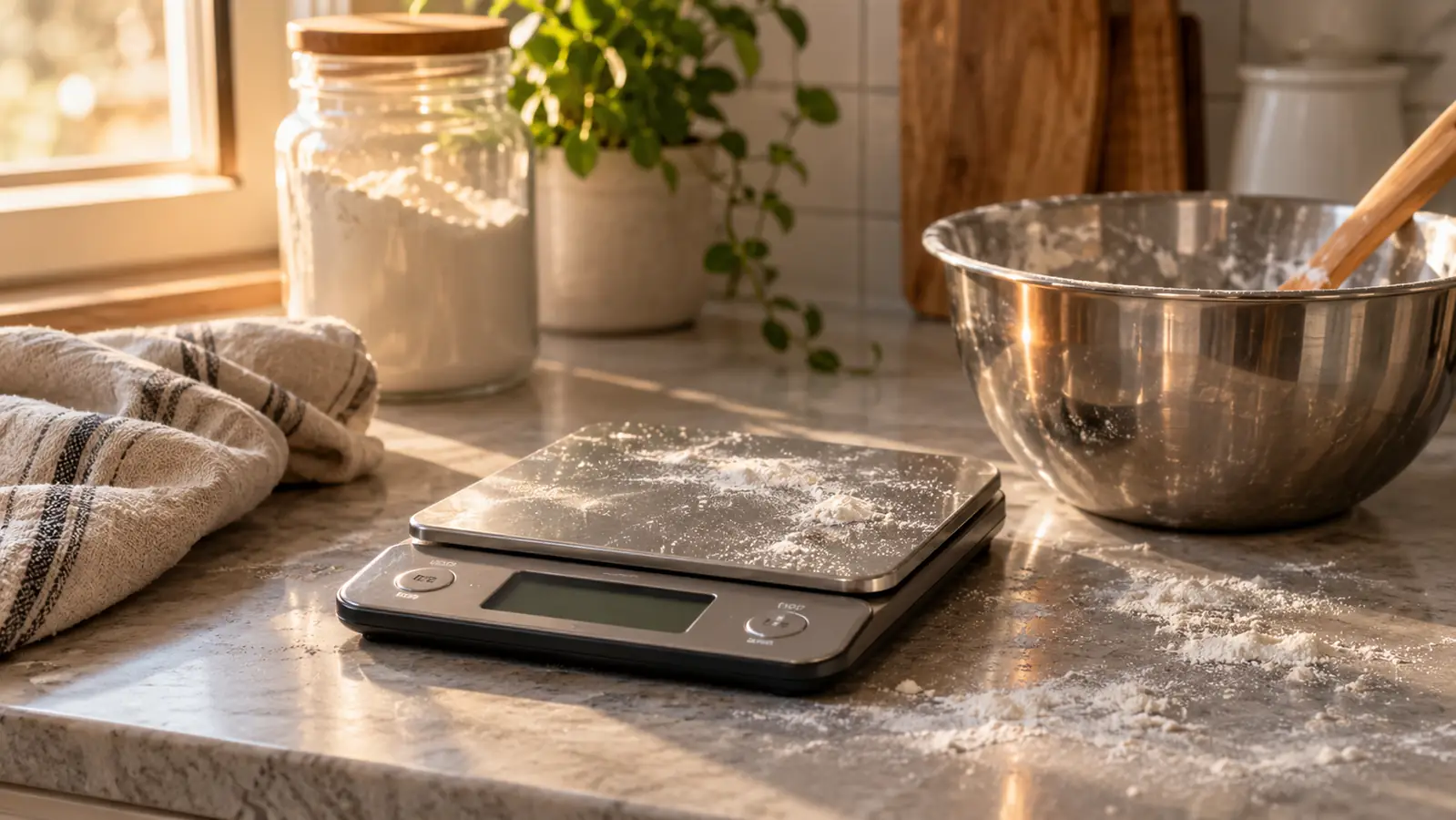
The Etekcity kitchen scale has sat on my counter for two years, wedged between the flour canister and the tea tin, and it is the least romantic tool I own. It does not fold. It does not talk to anything. It has one job and it does that job. But here is the part nobody puts in a review: for a home baker, a scale is not really a gadget. It is the difference between a loaf you can make again next Saturday and a loaf you cannot explain to anybody, including yourself. I bake most weekends in a small 1950s kitchen in Lancaster, with a gas oven that runs about fifteen degrees hot, and this little Etekcity has been in the middle of nearly every one of those bakes.
So this is the honest version. Not the version that reads the specifications back at you, but the one I would give a neighbor who knocked on the door and asked whether she needed one. It is accurate enough for what we do at home. It is small enough to leave out, which matters more than people admit in a kitchen with two feet of usable counter. And it has a few habits that will annoy a certain kind of cook. I will tell you about those too, because a review that only lists what works is not a review, it is a brochure.
The Quick Verdict
Accurate to the gram, small enough that you will actually leave it out, and honest about what it can and cannot do. Buy it for bread and cookies, not for the sense that you have bought a precision instrument.
Amazon Check Today's Price →The scale that actually earns its counter space
Eleven pounds of capacity, one gram resolution, a tare function that saves you three bowls, and a stainless platform you can wipe with a damp cloth. Not fancy. Just the one I reach for every Saturday.
Amazon Check Today's Price on Amazon →What Nobody Tells You About a Cheap Kitchen Scale
The first thing nobody tells you is that the grams do the work and the brand does almost none of it. The winter before last I baked the same sandwich bread three Saturdays running and weighed my flour for the first time instead of scooping it. Three and a half cups, scooped the way I had done it for thirty years, came out at 425 grams one Saturday and 361 grams the next. Same bag of flour, same cup, same hand, same kitchen. That is a sixty-four gram swing, roughly half a cup, and it explains a good many loaves I spent years blaming on the weather or on my own carelessness. Once I started weighing out five hundred grams and holding it there, my bread stopped coming out two different ways on two different weekends. That change did not come from spending a lot. It came from the number on the display, and the Etekcity gives me that number to the gram.
The second thing is that accuracy at this end of the market is not the problem people imagine. One gram of resolution on an eleven pound scale is more than enough for bread, cookies, pie dough and layer cakes. Out of plain curiosity I once set a sealed five pound bag of sugar on the platform and it landed within a few grams of the number printed on the paper, which told me everything I needed to know about whether the thing was telling me the truth. Where inexpensive scales come apart is not in the resolution, it is in how they behave when you use them carelessly. Set a heavy bowl down gently, tare it, and start weighing, and most of them will be fine. Slam down a full bowl of dough, tare, pour, tare, four times in a row while you are in a hurry, and a tired sensor can start drifting on you. That is the real risk. You manage it by being a little gentle rather than by spending three times as much.
The third thing, and the one I wish someone had said to me years ago, is that a scale does not make you a better baker. It makes you a more repeatable one. Those are different things. You can weigh every ingredient to the gram and still overproof the dough because the kitchen got warm while you were on the phone with your sister. You can hit the exact numbers and still scorch the bottoms because the oven runs hot and the pan is thin. What the scale buys you is the ability to change one variable at a time and know what actually happened. That is worth a great deal. It is also not the same as talent, and no display is going to hand you that.
How I've Used It in My Kitchen
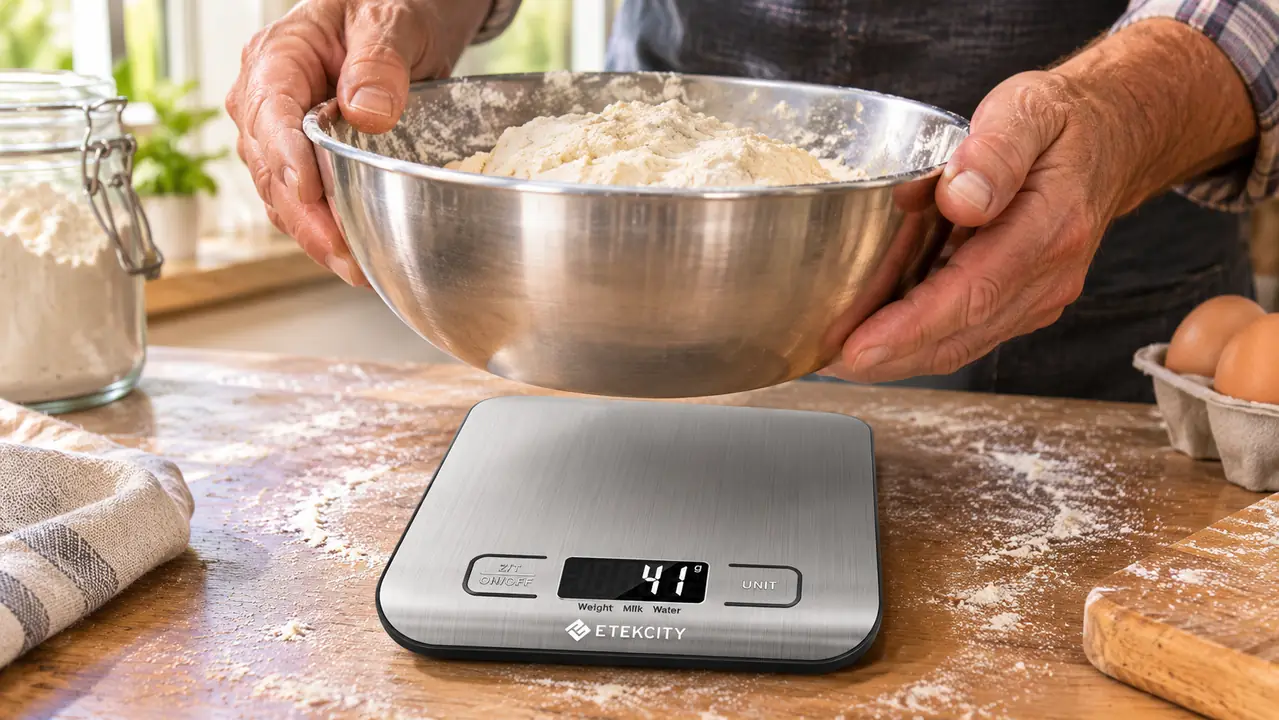
My Sunday routine has not changed much since I retired from the middle school library. Bread on Saturday morning, cookies or a pie on Sunday afternoon, and a layer cake whenever the church bake sale or a birthday demands one. The Etekcity gets used at least four times in a single bread bake. Once for flour, once for water, once for salt and yeast together in a small dish, and once to check the divided dough so the rolls come out the same size. That last one is where a home scale quietly earns its place. Last month I turned a two pound batch of dough out onto the board and cut it into eight pieces, and every one of them landed between 111 and 114 grams. They came out of the oven looking like siblings. Before I weighed them I cut by eye, and I would always end up with two pieces nearly half again the size of the smallest, and those two would be dark on the bottom while the little ones were still pale.
The tare function is the part I use most and the part I would miss most. Set the mixing bowl on the platform, press the button that zeroes it, and the bowl disappears from the math. Add flour, zero again, add water. It sounds trivial written down. In practice it means I dirty one bowl instead of four, and I stopped keeping a scrap of paper with subtraction scribbled on it beside the sink. For anyone who bakes with a husband leaning over the counter asking what smells so good, that is a real improvement in mood as well as in accuracy.
The five units are more useful than I expected, though not in the way the listing suggests. I use grams almost exclusively. Ounces show up when I am reading an older American recipe from a community cookbook and do not want to convert in my head. The fluid ounce and milliliter readings I have used maybe a dozen times, mostly for a jelly roll pan of water when I am setting up a water bath, or when I want to check whether a measuring cup is telling me the truth. It is a nice thing to have. It is not why I keep the scale on the counter.
What the scale buys you is the ability to change one variable at a time and know what happened. That is worth a great deal. It is not the same as talent.
Where the One Gram Readout Earns Its Keep
Salt, yeast and baking powder are where one gram matters most and where cups and spoons fail hardest. A teaspoon of table salt is somewhere around six grams, but a teaspoon of flaky kosher salt is closer to three, and a teaspoon of fine sea salt lands somewhere in between. If a bread recipe says twelve grams of salt, then twelve grams is twelve grams no matter which box is in the cupboard that week. I learned that the hard way with a rye loaf that tasted like a pretzel because I had used the fine salt when the recipe was written for the coarse. Same story with yeast. A packet is a convenience, not a measurement, and weighing five grams out of a jar is more consistent than hoping the packet was still alive. Baking powder is the one that catches people on cakes, because a level teaspoon and a heaped teaspoon are two different cakes.
Pie dough is the other place the display earns its keep, and it took me a while to trust it there. My mother's recipe calls for eight ounces of flour, which is 227 grams, and I used to sift and scoop and hope for the best. Now I weigh the flour and weigh the butter, cut the butter in until the pieces are the size of peas, and add ice water a tablespoon at a time until the dough just holds together. The scale cannot tell me when to stop adding water. Nobody's scale can. What it can tell me is that I have added four tablespoons instead of six, and that is often the difference between a crust that rolls out on the first try and one that fights back and tears at the edge of the pan.
I also weigh my bowls now, which sounds fussy and takes about ten seconds. A stainless bowl I use for dough weighs what it weighs, and knowing that number means I can put the whole thing on the platform after the first rise and see how much the dough actually gained. That is not a technique from a professional bakery. It is just something a scale makes possible, and it taught me more about what a proper rise looks like than any paragraph I have read on the subject.
The Parts That Still Annoy Me
The platform is small, and the listing is honest about it with the word mini. That is fine for a cereal bowl and less fine for the wide mixing bowl I use for a double batch of cookie dough, which is eleven inches across at the rim and overhangs the platform on both sides like a hat that does not fit. When that bowl goes on, it covers the display entirely, so I set it down, glance at the number, then lean back like a woman reading a label without her glasses. I have worked out a small routine to get around it. I add the last of the flour in two pours so I can read the display in between, and I keep the bowl turned so the handle is not over the screen. I have gotten used to it. I have not stopped noticing it, and I do not expect to.
The stainless surface is easy to wipe, which I appreciate every single time I dust flour across it. It also shows every fingerprint, and if you set a wet measuring cup down on it you will be wiping a ring off later. This is cosmetic. It does not affect a single number. It still means the scale looks a little tired after two years of weekly use, and I am the sort of person who notices a thing like that and then mentions it in a review.
The batteries are two AAAs, they came installed in the box, and I have replaced them once in two years. I bring it up only because the battery door on an inexpensive kitchen tool is often the first thing to give out, and this one has not. That is not a promise about yours. It is simply what happened at my house, and I would rather tell you the small true thing than the large vague one.
What I Liked
- One gram resolution up to eleven pounds, which covers every home baking job I have thrown at it
- Tare function means one bowl instead of four, and no arithmetic on a scrap of paper
- Compact enough to leave on a counter with almost no free space
- Stainless platform wipes clean with a damp cloth after a flour mess
- Backlit display with large characters, readable in a dim morning kitchen
- Five units including grams, ounces, pounds and ounces, fluid ounces and milliliters
Where It Falls Short
- Small platform, so a wide mixing bowl covers the readout and you have to lean back
- Stainless surface collects fingerprints and water rings
- Light enough that a careless hand can slide it across the counter
- Will not fix an uneven oven or a thin pan, no matter how carefully you weigh
- Finish looks worn after a couple of years of weekly use
Who This Is For
If you bake bread or cookies most weeks and you are still scooping flour out of the bag with a measuring cup, this is the upgrade with the best return for the least fuss. It is also right for a small kitchen, because it does not need a drawer and it does not need a ritual. And it suits the person who wants one honest tool rather than a matched set of gadgets that all need batteries. My husband Dale spent forty years as a machinist and has strong opinions about measuring instruments. He put a nickel on it once out of curiosity, said something approving, and went back to the newspaper. That is the highest praise this house offers.
Who Should Skip It
Skip it if you regularly weigh things in the tens of pounds, because eleven pounds is the ceiling and a scale that gets pegged is not helping anyone. Skip it if you want a tool that remembers, connects, or logs, because this one does none of that and does not pretend to. Skip it if you are the sort of baker who will be irritated every single time a wide bowl blocks the readout, because that will happen and it will keep happening. And skip it if what you actually need is better pans and an oven thermometer. I spent years blaming my measurements for uneven results that turned out to be a thin pan and an oven running hot. A scale is a wonderful thing. It is not the whole answer, and I would be doing you a disservice to say otherwise.
Accurate to the gram, small enough to actually keep out
Two years of Saturday bread, Sunday cookies and a fair number of birthday cakes, and it is still the scale I reach for first. If you want repeatable results without a drawer full of gadgets, this is where to start.
Amazon Check Today's Price on Amazon →