
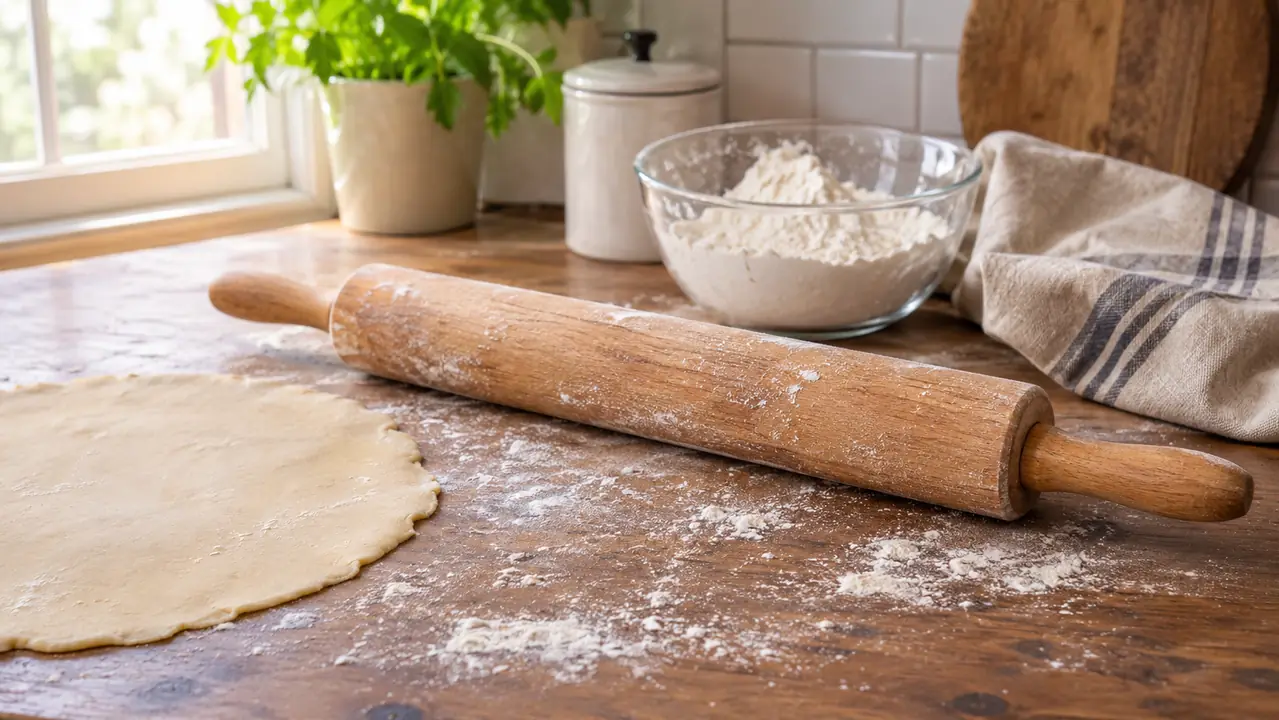
The first pie crust I rolled with the Farberware Classic Wood Rolling Pin came out round, which sounds like a low bar until you have spent twenty years rolling lopsided ones with a drinking glass and a short temper. I bought it two years ago at the hardware store on King Street because the pin I had inherited had a hairline crack down the barrel that grabbed dough every time I got near the edge. I was tired of patching crusts with wet fingers like a mason repointing a wall.
It is a plain thing. Eighteen inches of hardwood, one pound on my kitchen scale, a handle at each end, nothing to adjust and nothing to take apart. Farberware has been making kitchen tools for a very long time and this pin looks like it knows that. Since then I have rolled crusts for two Thanksgivings and a church bake sale, cutout cookies by the hundred, biscuits most Sundays, and one batch of pastry I will not be discussing. Here is what two years of weekend baking has taught me about it.
The Quick Verdict
A one-pound hardwood pin that rolls even, wipes clean in ten seconds and fits a shallow drawer. It will not chill your dough and it will not turn you into a pastry chef, but it never once made a crust worse.
Amazon Check Today's Price →The pin I reach for before the heavy one in the back of the cupboard
Eighteen inches of hardwood, one pound, balanced end to end. It is the least interesting tool on my counter and the one I use most weekends.
Amazon Check Today's Price on Amazon →How I've Used It
My kitchen is a 1950s galley with about four feet of usable counter and a gas oven that runs fifteen degrees hot, so I have learned to work in small batches and to keep tools that earn their footprint. Dale, my husband, is retired from the machine shop and has become my most honest taste tester, mostly because he will tell me a crust is tough without softening it. In two years I have not once had a reason to put this pin away in a cupboard I cannot reach. It lives in the top drawer with the bench scraper.
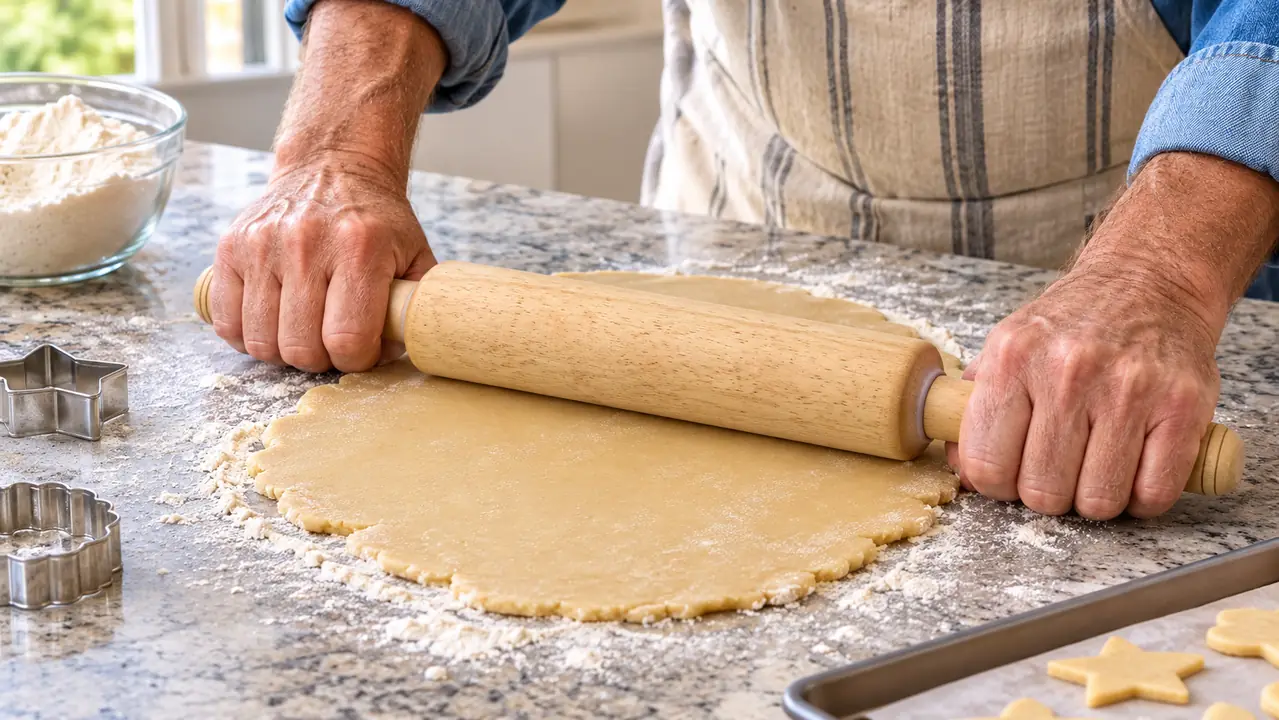
The work is unglamorous. I make a butter crust, chill it in two discs, and roll each one out on a lightly floured board. The pin goes from the center outward, I lift and turn the dough a quarter turn every few passes, and I keep the flour light because too much of it makes a crust that tastes like paste. That is the entire technique. What the pin contributes is a barrel that does not snag and a weight that does the pressing for me, so I am not leaning on it with my shoulders the way I used to with a glass.
Cookies are where it gets the most hours. Every December I make cutouts for the church bake sale, six or seven trays of them, and the job depends entirely on rolling to an even thickness so the shapes bake at the same rate. With my old pin I would get thin edges and a thick middle and end up with a tray of cookies where half were browning and half were raw. The Farberware rolls flat enough that I stopped noticing the difference, which is the highest compliment I can pay a rolling pin. Biscuits get the same treatment at half an inch, gentle pressure, as few passes as possible.
The first December I owned it I kept a note taped to the refrigerator door: two passes, quarter turn, two more. By the third tray I did not need the note. Last fall I rolled forty-two stars and forty trees in one afternoon and every one came off the board at the same thickness, which meant the whole batch went into the oven and came out at eleven minutes instead of me pulling two trays early and putting two back in. If you have ever set out a bake sale table where half the cookies are pale and half are dark at the edge, you know why I care.
What the Hardwood Actually Does for the Dough
The listing calls the material rosewood and describes it as a moisture-resistant hardwood with a smooth surface that will not drag. I can speak to the drag part from direct experience. A light dusting of flour is enough with this pin. Dough releases from the barrel on its own instead of clinging and tearing, and that matters more than any other feature because a crust that tears at the edge is a crust you have to patch, and patches show. My first Thanksgiving with it, I rolled four crusts in a row without reflouring the board once.
I tested the drag claim the wrong way first, because I am stubborn. The second week I had the pin, I tried rolling sugar cookie dough with no flour at all, just to see whether the smooth surface lived up to the description. It did not. The dough stuck across the middle of the barrel and came off in a ragged sheet, and I had to ball it up and start over. What I learned is that the pin wants a light dusting, not none, and that the difference between light and heavy is about a tablespoon. Once I stopped trying to prove a point, my flour use dropped by half from what the cracked pin demanded, because I was no longer over-flouring to make up for a surface that grabbed.
The surface has stayed smooth. There is no raised grain, no rough patch near the handles, no place where the finish has worn through to something that catches. Two years of weekly use and it looks like a pin that has been used, which is what I want. What it has not done is chip or split, and given what happened to the pin it replaced, I pay attention to that.
What the hardwood does not do is chill. If a recipe tells you to roll on a cold surface, this is not that surface, and no amount of flour will fix a dough made with butter that was too warm to begin with. I keep a marble board for laminated dough in July, and I will say plainly that the pin is not the thing standing between you and good pastry on a hot day. Your butter temperature is. Anyone who tells you a rolling pin solves that is selling something.
Pie Crust, Cutout Cookies and Biscuits
Pie crust is the hardest test and the one where the difference shows. A single crust for a nine-inch plate needs a circle about twelve inches across, which means working out from the middle with even pressure and resisting the urge to press down hard at the end. The barrel on this pin is listed at seventeen and a half inches long and about two and a half inches across, so there is plenty of width to cover the whole circle in a few passes rather than fifteen small ones. Fewer passes means less gluten and a shorter, flakier crust. Mine got noticeably better and I am honest enough to say that some of the improvement was practice, not hardware.
The crust I carried to Thanksgiving two years ago was the first one I could hold up on my open hand without a crack at the fold. I have made the same butter crust since 2009 and the rolling is the only part of the process that changed. Dale noticed before I said a word, which from a man who describes most desserts as fine is a genuine review.
For cutout cookies, the fixed handles are the thing. I can hold both ends and drive the pin straight across a sheet of dough without it wandering, and I can feel the resistance change when I hit a thick spot. I roll between two sheets of parchment most of the time now, and the pin rides over the top sheet without wrinkling it, which the tapered French pin I borrowed for a season did not manage nearly as well.
Biscuits are quick work. I pat the dough out first, then give it two or three light passes at half an inch, and the pin's one pound is enough weight that I am guiding rather than pressing. If you have wrist trouble, that difference is real. I am sixty-one and I have baked through a flare of tendonitis in my right hand, and this is one of the few tools in the drawer I could keep using through it.
Forty-odd pie crusts over two years and the barrel has never once grabbed the dough. The cracked pin it replaced grabbed every single one.
The Handles, the Weight and My One Drawer
The handles are described as designed for control and reduced hand fatigue, and I can confirm the fatigue part without any marketing language attached to it. They are thick enough to grip without my fingers cramping and they are set so my hands sit level with my wrists. When I do six trays of cutouts in an evening, that is the difference between finishing the last tray and deciding the last tray can wait until morning.
One pound is the sweet spot for me. A heavier pin does more of the work but tires my forearm on thin dough, and a lighter one has me pressing to get any result at all. This one is balanced end to end, so I am not fighting it when I turn the dough or roll back toward myself. I noticed the balance the first week and I have stopped noticing it since, which is what balance is supposed to do.
Storage was the deciding factor and I did not expect it to be. The full length is under eighteen inches and the barrel is narrow, so it slides into my top drawer alongside the bench scraper and the measuring sticks without catching on anything. My mother's pin was a heavy tapered one that lived in a crock on the counter for thirty years because it did not fit anywhere else. In a kitchen this size, a tool that stores flat and out of the way gets used, and a tool that lives on the counter gets moved aside.
I measured the drawer before I bought it, because I have carried home one too many tools that turned out to be an inch too long for anywhere I had to put them. Seventeen and a half inches long, about two and a half across at the widest point, and it slides in with room to spare. The drawer closes without a shove. That sounds like a small thing until you have spent years shifting a crock from one end of the counter to the other every time you needed the space to roll something out.
Where It Falls Short
There are no thickness guides on it. If you want a consistent quarter inch for gingerbread, you will be setting two dowels or two measuring sticks on either side of the dough and letting the pin ride on them. I do it, it takes four extra seconds, and I would rather have that than etched rings that collect flour. But if you are buying this expecting a guide, it does not have one, and you should know that before it arrives.
Sticky doughs will still stick. Gingerbread, anything with a lot of molasses, and a wet slack dough will grab at the wood no matter how much flour you dust, and the honest answer is parchment on top and bottom. Wood is also wood. I wipe the barrel with a damp cloth and dry it immediately and I never soak it, and I do not leave it sitting in the sink with the dishes. That is a small habit, but it is a habit, and a stainless or marble pin would not ask it of me.
What I Liked
- The smooth hardwood surface releases dough with only a light dusting of flour, so crusts stop tearing at the edges
- One pound and balanced end to end, which means you guide the pin instead of pressing it
- Handles are thick and level with the wrists, so long cookie sessions do not cramp the hands
- Under eighteen inches and narrow enough to slide into a standard kitchen drawer
- Wipes clean with a damp cloth and needs no assembly, parts or maintenance beyond drying it
Where It Falls Short
- No thickness guides, so you need dowels or measuring sticks for even cutouts
- Sticky and high-molasses doughs still require parchment on both sides
- It is wood, so it cannot be soaked or left in the sink, and it will not chill dough
- A tapered French pin still gives finer control for very thin pastry work
Who This Is For
This is the pin for someone who bakes pies and cookies most weekends and wants a tool that behaves the same way every time. It suits a small kitchen, since it stores flat and takes up almost no room. It suits anyone replacing a pin that has cracked, split or started snagging, because the improvement is immediate and obvious. It suits bakers who have wrist or hand trouble and want the pin's own weight to do part of the work. And it suits anyone who would rather spend their money on good butter than on a pin with a mechanism inside it. I have recommended it to two neighbors and one of them now uses it for her grandkids' cookies every month.
Who Should Skip It
If you roll laminated dough in a warm kitchen all summer, you want marble, and no hardwood pin is a substitute for a cold surface. If you need exact thickness without setting up dowels, buy a pin with guides built in. If you have a strong preference for the tapered French style, where your hands rest on the pin itself and the ends do nothing, this will feel clumsy in comparison, and that is a real preference, not a flaw in the tool. And if you know yourself well enough to know that a wooden tool will end up in the dishwater, buy something that can take it. A good inexpensive pin ruined by a habit is still a ruined pin.
If your pin has a crack in it, replace it before the next pie
That hairline split is what grabs the dough and tears the edge you have to patch. Eighteen inches of hardwood, one pound, and it fits the drawer you already have.
Amazon Check Today's Price on Amazon →