
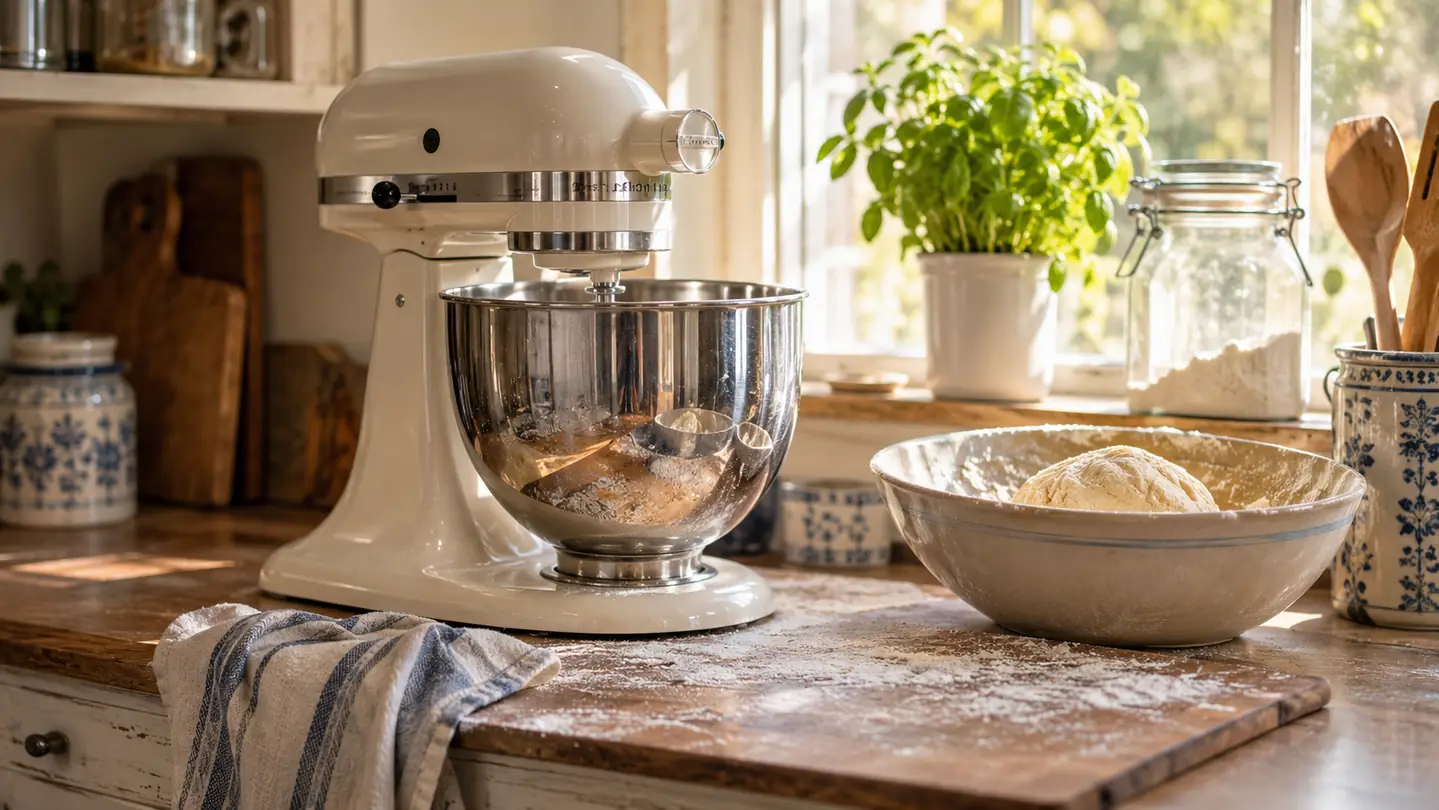
I have owned my KitchenAid Artisan long enough to stop being polite about it. There is a great deal to like here, and there are a handful of things that still make me exhale sharply every time I slide it out from under the cabinet. So this is the honest version, the review I wish someone had handed me before I bought one: the parts that earn their keep, the parts that irritate me, and a straight answer about whether a stand mixer deserves permanent counter space in a small kitchen.
For context, I am sixty-one, retired from a middle-school library, and I bake most weekends. My kitchen is a 1950s galley with a gas oven that runs about fifteen degrees hot and a stretch of counter you could cover with a dish towel. Sandwich bread, cookies, a pie most months, and layer cakes for the church bake sale every fall. Dale, my husband, is the honest taster and the one who lifts heavy things. That last part turned out to matter more than I expected.
The Quick Verdict
A capable, heavy, long-lived mixer that kneads two loaves without complaint. It is held back by its footprint, its weight, and a one-year warranty that undersells the machine.
Amazon Check Today's Price →If you have the outlet and the counter, this is the one I would look at first
I check the current price before I recommend anything to anyone. Measure your counter and the gap under your cabinets first, then go look.
Amazon Check Today's Price on Amazon →How I've Used It
I have run this mixer through five kinds of work: white bread dough at two loaves a batch, cookie dough stiff enough to bend a wooden spoon, cake batter, buttercream, and one regrettable experiment with a dry rye that I will not repeat. It never stalled, it never smelled hot, and it never needed a second pass at a stubborn lump. The motor is rated at 325 watts, which is not the largest figure you will see on a spec sheet. Paper is not what kneads dough, though, and this one kneads.
The control is a sliding lever on the side that steps through ten speeds. I use the bottom two for folding flour into a batter so it does not end up on the backsplash, the middle for creaming butter and sugar, and the top end only for whipping cream or egg whites, because the highest settings are genuinely fast and will take cream past soft peaks while you are turned away. The bowl lifts out, which sounds like a small convenience until you have spent a winter scrubbing a bowl that was bolted to the machine.
What surprised me is how much of the job is the machine simply staying still. The body is zinc and it is heavy, and that weight is the reason I can start a stiff dough and walk to the pantry without the mixer creeping toward the edge of the counter. The hand mixer I used for years had to be watched like a toddler near a staircase. This one sits where you put it and works while you get on with something else, which is the entire point of owning one.
The first month was a learning curve in one specific way: I kept trying to use it like a hand mixer, which means I kept stopping it to scrape down the bowl. You learn to let it run and scrape once or twice per batch instead. I also learned that the slow speeds exist for a reason, and that starting a stiff dough on a high setting is how you get flour on the ceiling. None of this appears in any manual I have read, which is a general complaint I have about manuals.
What It Does Well
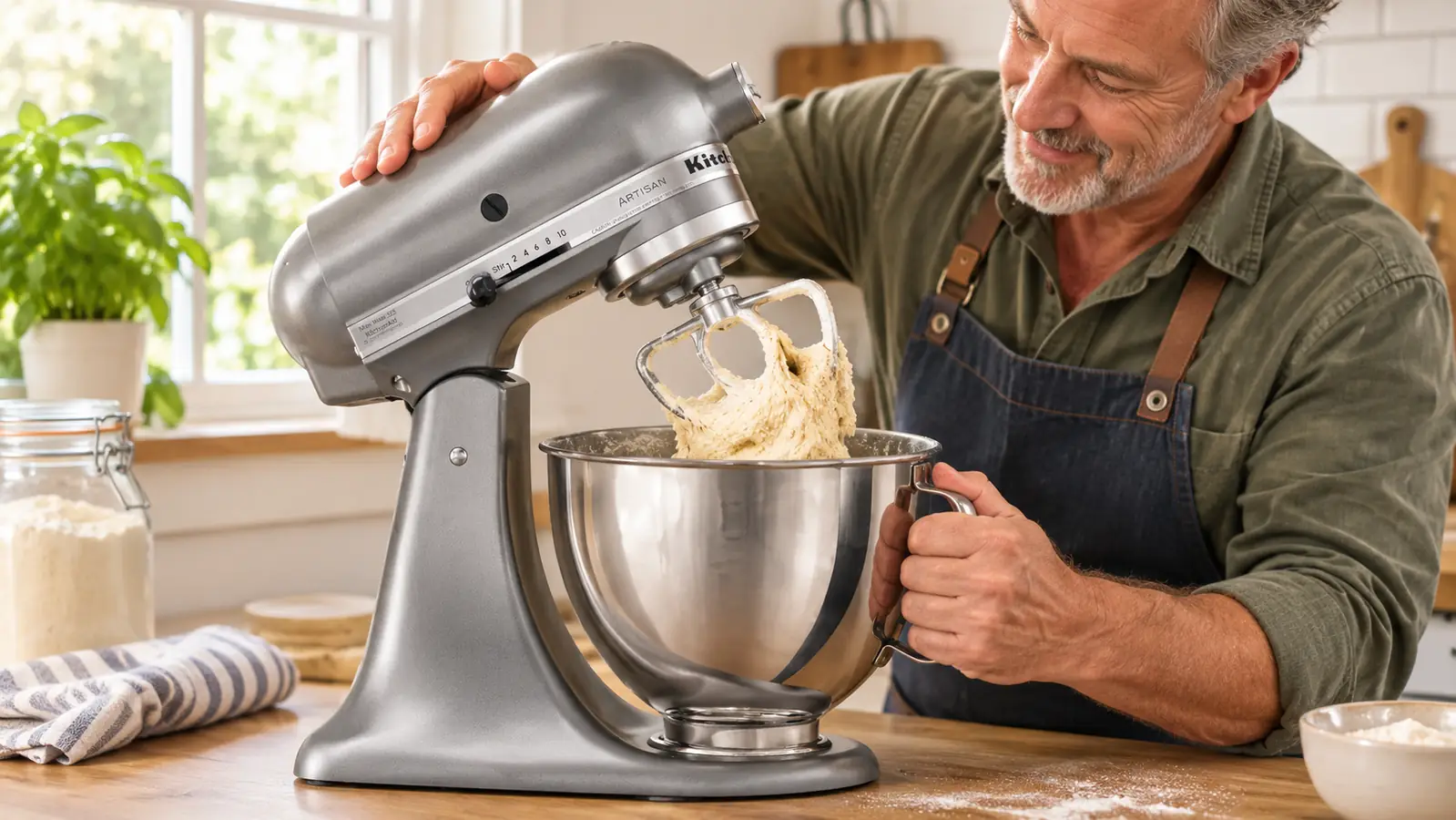
Bread is the honest test and this passes it. Two loaves of a fairly stiff white dough, kneaded without a pause, without the motor changing pitch, without the bowl shimmying loose. I made that dough by hand for years and I know what it should feel like when it comes together. The mixer gets it there in about the time it takes to put the flour away and wipe down the board, which leaves me something better than tired arms at the end of it.
The ten speeds are not a marketing list. The low end is slow enough to be useful, which is the part cheap mixers get wrong. When you add a cup of flour to a wet batter, you want it folded in, not flung. I can do that here at the first or second setting and keep the counter clean. The high end is fast enough that whipping a half pint of cream is a two-minute job rather than a five-minute one, and it holds a steady speed instead of surging.
The five-quart bowl is bigger than I thought I needed and it turns out to be the right size. Two loaves of bread fit. A double batch of cookies fits. A two-layer cake fits with room to spare. It lifts out, it goes in the sink, and the curve at the bottom is easy to scrape with a flexible spatula. I have never once had to tilt the whole machine to get the last of the batter out of it.
What I did not expect to care about is the feel of the thing. The head tilts with a solid weight to it, the speed lever moves in definite steps instead of sliding vaguely, and nothing on the machine rattles while it runs. I have owned appliances that felt like they were assembled from a kit and sounded like it too. This does not. Whether that is worth what it costs is a question only you can answer, but it is the reason mine has stayed on the counter instead of migrating to the basement shelf.
And it is quiet enough for a Saturday morning. Not silent. I can hear it from the dining room with the door open, and it has a low tone that carries down to the basement stairs. But I have run it at seven in the morning without waking Dale, and he spent forty years around machinery, so he notices sound.
What Nobody Tells You Before You Buy
The listed weight is ten thousand grams. That is ten kilograms, or about twenty-two pounds, and it is the single fact I most wish I had absorbed before the box arrived. Dale lifted it onto the counter, set it down, and we both looked at it for a moment, because it was obvious this was not an appliance that would be going back into a cupboard between uses. I do not lift mine. I slide it, with both hands. If you cannot picture a permanent spot for it, that is your answer right there.
The base measures 8.7 inches wide by 14.1 inches deep, and the machine stands 13.9 inches tall with the head down. On a counter with maybe four feet of usable work surface, that is a real fraction of the room. The height is the sneakier problem. The head tilts back to open up the bowl, and it needs air above it to do that. My upper cabinets are low, so when I bake the mixer sits at the front edge of the counter, and there is no arrangement where it lives pushed back against the wall. Measure the gap under your cabinets before you buy. I did not.
The cord is 36 inches. In a kitchen built when outlets were an afterthought, that is short. My nearest counter outlet is behind the sink, so the mixer lives at the end of the counter closest to it rather than in the corner where the light is best. I thought about an extension cord and decided against it, because a cord stretched across a work surface is how people trip with a bowl of batter in their hands. If you have an outlet within three feet of where you want to mix, ignore this paragraph entirely.
The warranty on the KitchenAid Artisan is one year, hassle-free replacement. Mine has needed nothing, so this is not a complaint about service. It is a complaint about proportion. A ten-kilogram machine with a zinc body, sold as the sort of thing you hand down to somebody, should not be covered for as long as a cheap toaster. Read that line on the listing and decide how much it bothers you. It bothers me a little.
Cleaning is the unglamorous part nobody mentions. The head of the machine hangs over the bowl, so flour dust collects on the underside and in the seam where the head meets the base. A damp cloth gets it, but you have to think to do it, and I did not think to do it for the first month. The bowl and the beater go in the sink. The machine itself gets wiped, not washed, and it is heavy enough that wiping around it is a two-handed job if you do not want to move it.
There is also a workflow cost. Because the machine lives on the counter, it takes up the spot where I used to roll out pie dough. I now roll dough on the dining table with a pastry cloth, which works fine and is not what I did for thirty years. If your counter is tight, think through where the bowl and the rolling pin and the cooling racks are all going to go, not just where the mixer will sit.
The listing gives a noise level of 4 decibels, which cannot be accurate. Four decibels is closer to a quiet bedroom than to a machine kneading dough. Treat that number as decorative and go by the reviews that actually mention sound. Mine hums, it has a tone, and it is not unpleasant. It is simply not four decibels, and I would rather tell you that than pretend the spec sheet is gospel.
Here is the part I most want to be straight about. A stand mixer did not make me a better baker. It does the stirring I was already doing, with more patience than my arm has at six in the morning on a Sunday. What actually changed my bread was a scale and a notebook, and the mixer mostly bought me the ability to make two loaves instead of one without standing at the counter for twenty minutes. That is worth paying for. It is not the same thing as skill, and any review that tells you otherwise is selling something.
What I Liked
- Kneads two loaves of stiff dough without stalling or shifting on the counter
- Ten speeds, and the low end is slow enough to fold flour in without a cloud
- Five-quart bowl lifts out for washing and is easy to scrape
- Heavy zinc body stays planted during long mixing jobs
- Quiet enough to run early in the morning in a small house
Where It Falls Short
- About ten kilograms, so it stays where it is put unless someone strong moves it
- Needs vertical clearance above it to tilt the head back
- 36-inch cord is short for an older kitchen
- One-year replacement warranty on a machine built to last decades
- Takes permanent counter space, which is a real cost in a small kitchen
Two loaves of stiff dough, eight minutes of kneading, and the machine never shifted an inch on the counter.
Stand Mixer Versus the Hand Mixer in the Drawer
I kept my hand mixer for two years after this arrived, and I still use it for small jobs. A single batch of muffins, a bowl of whipped cream for two people, anything that fits in a two-quart bowl. It is faster to get out, faster to wash, and it lives in a drawer. For a small amount of work, the hand mixer wins and it is not close.
Where the stand mixer takes over is volume and endurance. Anything that runs longer than about four minutes and my wrist starts to complain, and my wrist is sixty-one years old and has opinions. Stiff cookie dough, bread, buttercream for a bake sale where I am icing four dozen cupcakes, that is stand mixer work. The honest split is this: a hand mixer for a Tuesday night, a stand mixer for a Saturday.
The Five-Quart Question
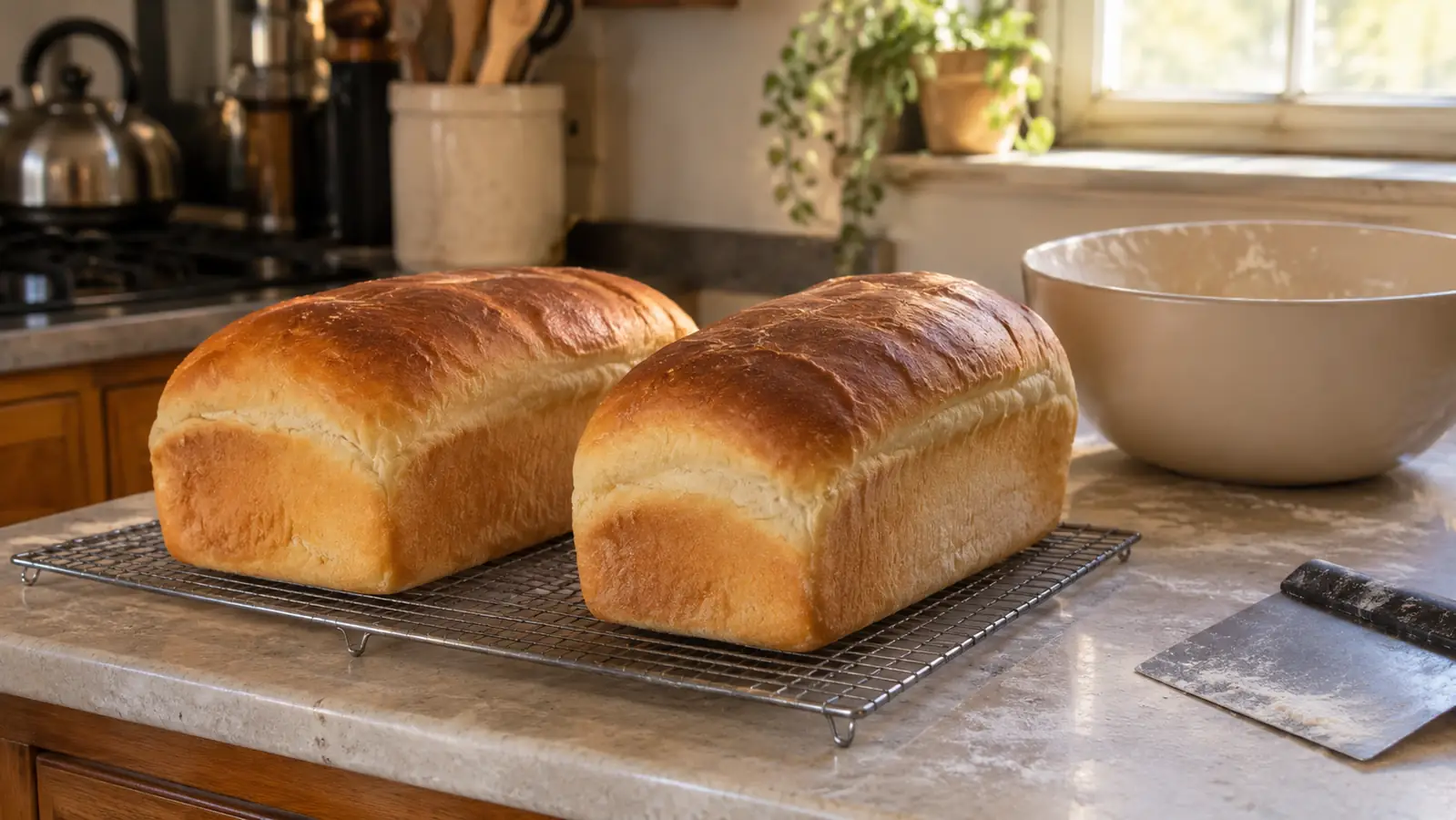
Five quarts is the number to settle before anything else. In practice that is two loaves of bread, a double batch of cookies, one two-layer cake, or enough buttercream to ice a sheet cake generously. It has been enough for everything I make and I have never come close to the rim. If you are mixing for a large family every week, or selling at a market, you already know you need more bowl than this, and this is not that machine.
The other half of the bowl question is access. On this KitchenAid the bowl lifts out and the head tilts back, so you can get a spatula down the side at an angle and scrape properly. I used a bowl-lift machine at a neighbor's house once and spent the whole afternoon working around the mechanism. For one or two batches at a time in a home kitchen, this arrangement is the friendlier one, and I would choose it again.
Who This Is For
This is for the person who bakes at least twice a month and is tired of holding a hand mixer until their forearm aches. It suits someone with a permanent stretch of counter, an outlet within three feet, and no illusions about putting it away. It also suits the person who would rather buy one good thing than replace three cheap ones, because the KitchenAid Artisan is built like the last mixer you will need to buy.
Who Should Skip It
Skip it if your kitchen is genuinely small and every appliance has to live in a cupboard. Twenty-two pounds coming out and going back in will wear you down by February, and you will resent it. Skip it if you bake a few times a year and mostly cookies, because a hand mixer does that in the same time with none of the footprint. And skip it if what you actually want is a bread machine or a food processor. This is neither, it will not become either, and buying it hoping otherwise is how appliances end up in the basement.
If the counter space is there, this is the mixer I would buy again
Measure the gap under your cabinets, check the current price, then decide. That is the order I would do it in.
Amazon Check Today's Price on Amazon →