
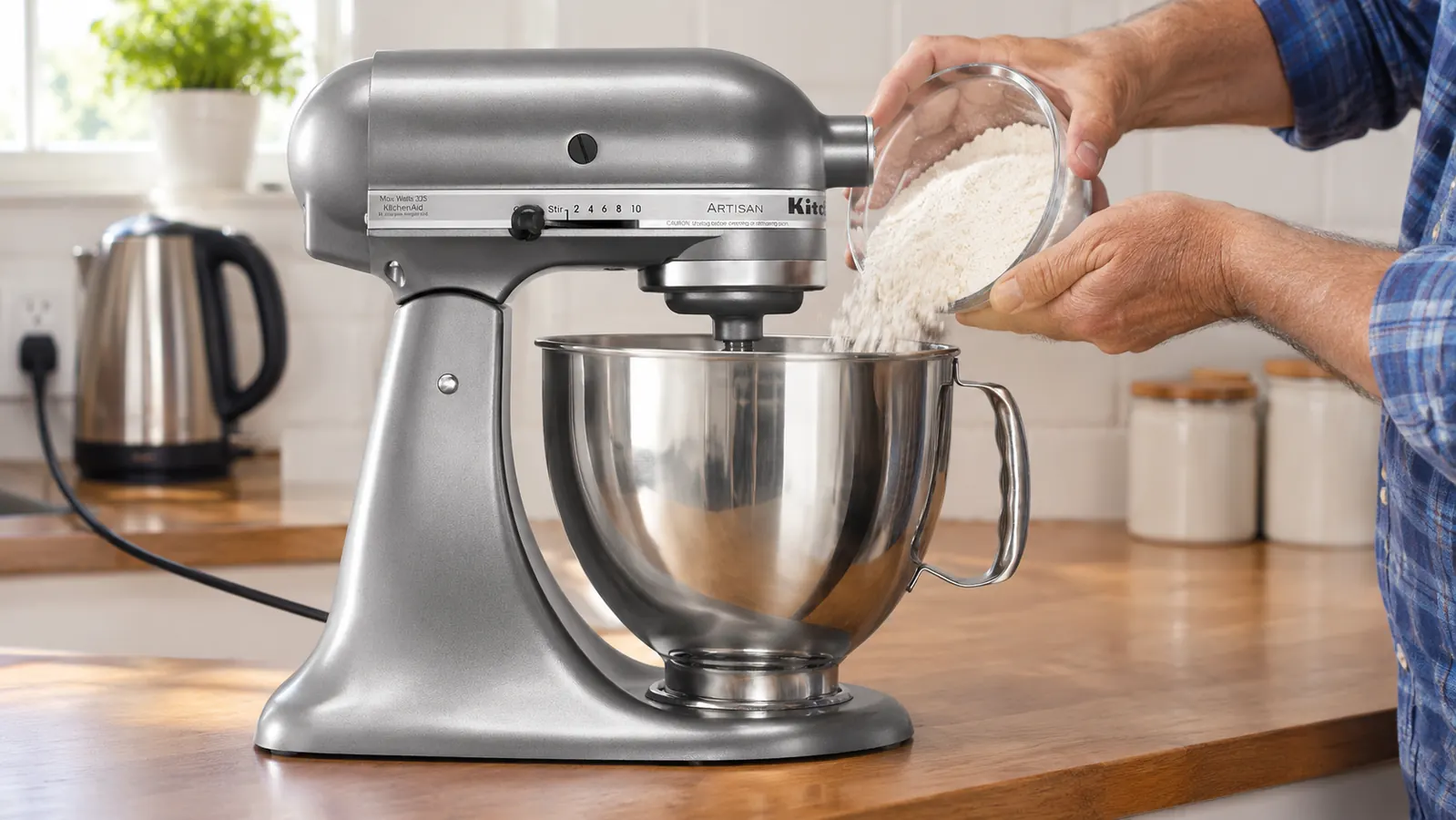
Short answer: they do different jobs, and the difference shows up the first time you make bread. The KitchenAid Artisan is a 5-quart tilt-head stand mixer with 10 speeds on a slide control and a bowl that holds two loaves. A good hand mixer is two beaters and a thumb switch that lives in a drawer. If you bake bread, double a cookie recipe, or frost a layer cake for the church bake sale, the stand mixer earns the counter. If you whip a cup of cream twice a month, it does not.
I have about four feet of usable counter in a 1950s kitchen, and I have owned both for years. The stand mixer stays out because lifting it in and out of a cupboard is worse than looking at it. The hand mixer lives in the drawer with the spatulas and comes out more often than you would guess. Here is the honest split between them, from someone who has washed both bowls more times than she can count.
| KitchenAid Artisan | A Good Hand Mixer | |
|---|---|---|
| Capacity | 5-quart bowl, enough for two loaves of bread or a double batch of cookie dough | No bowl of its own. You supply the bowl and the arm holding it |
| Speed control | 10 speeds on a slide control, from a very slow stir to a fast whip | Usually three to five speeds on a thumb switch |
| Stiff dough | 325 watts and a dough hook. It kneads while you grease pans | Strains on stiff dough, and you finish the last few minutes by hand |
| Hands free | Runs on its own. Both your hands are available for the next thing | One hand is occupied for the entire mix |
| Footprint | 14.1 inches deep, 8.7 wide, 13.9 tall, and it needs headroom to tilt | Fits in a drawer and comes out with one hand |
| Cleanup | The mixing bowl plus whatever attachment you used, and the bowl is the size of a small sink | Two beaters, rinsed in fifteen seconds |
| Small jobs | One cup of cream barely reaches the beater in a 5-quart bowl | Right-sized for a cup of cream or four egg whites |
| Moving it | Roughly 22 pounds. It stays where you set it down | Goes in a tote bag on the way to the church hall |
| Learning curve | You learn beater-to-bowl clearance and how the tilt head moves | Plug in and go |
| Warranty | 1 year hassle-free replacement from KitchenAid | Set by whichever maker you choose, so read it before you buy |
How I Ended Up With Both
Nobody plans to own two mixers. I started with the hand mixer because it was what fit, and for a few years it was genuinely enough. Cookies, a pan of bars, mashed potatoes at Thanksgiving, a birthday cake in a 9-inch pan. Then I started making sandwich bread on Saturdays and the hand mixer gave up somewhere in the second loaf, and I finished the kneading by hand with a dough too stiff for the beaters to move through.
The day it happened was a Saturday in February, cold enough that the kitchen window fogged over while the oven was on. The dough had come together fine in the bowl, but by the third minute the beaters were climbing and the motor was making a sound I had not heard before, a low strained whine that got worse when I pushed the switch higher. I stopped, turned the dough out onto the counter, and kneaded it by hand for the next ten minutes, which was longer than the recipe asked because my arms were slower than the machine. The loaves came out fine. They came out fine because I stood there and did the work, not because the mixer did.
The reason I bought the Artisan was not speed. It was that bread needs eight to ten minutes of kneading and I no longer have eight to ten minutes of standing still in me. Setting the dough hook on the slow end of the slide control and greasing two loaf pans while it works changed my Saturdays more than any other tool in that kitchen.
I am not going to pretend the mixer made me a better baker, because it did not. Weighing flour on a scale instead of scooping it did that. What the mixer did was make the same loaf repeatable, which matters more once you are baking for other people and not just for Dale and me.
Where the KitchenAid Artisan Wins
Bread is the clearest case. A stiff dough is the one job a hand mixer genuinely cannot do, and the dough hook handles it without the machine heating up or creeping across the counter. I run it on the slowest setting, the one that turns the dough over maybe once a second, and let it go for the full knead. Nine times out of ten I am washing the bowl I mixed the preferment in while it works.
The first Saturday I used it, I set it in the corner, plugged it in, and learned that the cord runs 36 inches, which was just enough to reach the outlet behind the canisters without dragging out an extension cord. I turned the slide control down to the slowest setting, watched the dough hook fold the dough over, and then walked away. I greased two pans, wiped the counter, and came back to a dough that had come together on its own. I have run that same routine most Saturdays since. The machine does not get hot and it does not walk toward the edge of the counter.
Creaming butter and sugar is the second case. Ten speeds on a slide control give you a low setting that folds, a middle that creams, and a fast end that whips, and the gaps between those settings are small enough to actually land on the one you want. A thumb switch on a hand mixer jumps from slow to fast with very little useful in between, so you spend the whole mix feathering it with your thumb and hoping.
Then there is the part nobody mentions, which is your hands. The mixer runs while you grease pans, crack eggs into a cup, or start the buttercream in a second bowl. My gas oven runs about 15 degrees hot, so I am checking the timer more than I would like, and having both hands free for that is worth something. The bowl holds 5 quarts, which is two loaves or a double batch of cookies, and the tilt head lifts the beater clear without unclipping anything.
The mixer did not make my bread better. Weighing the flour did. What the mixer gave me was the same loaf, on the same Saturday, without twenty minutes of standing over the counter.
Where a Good Hand Mixer Wins
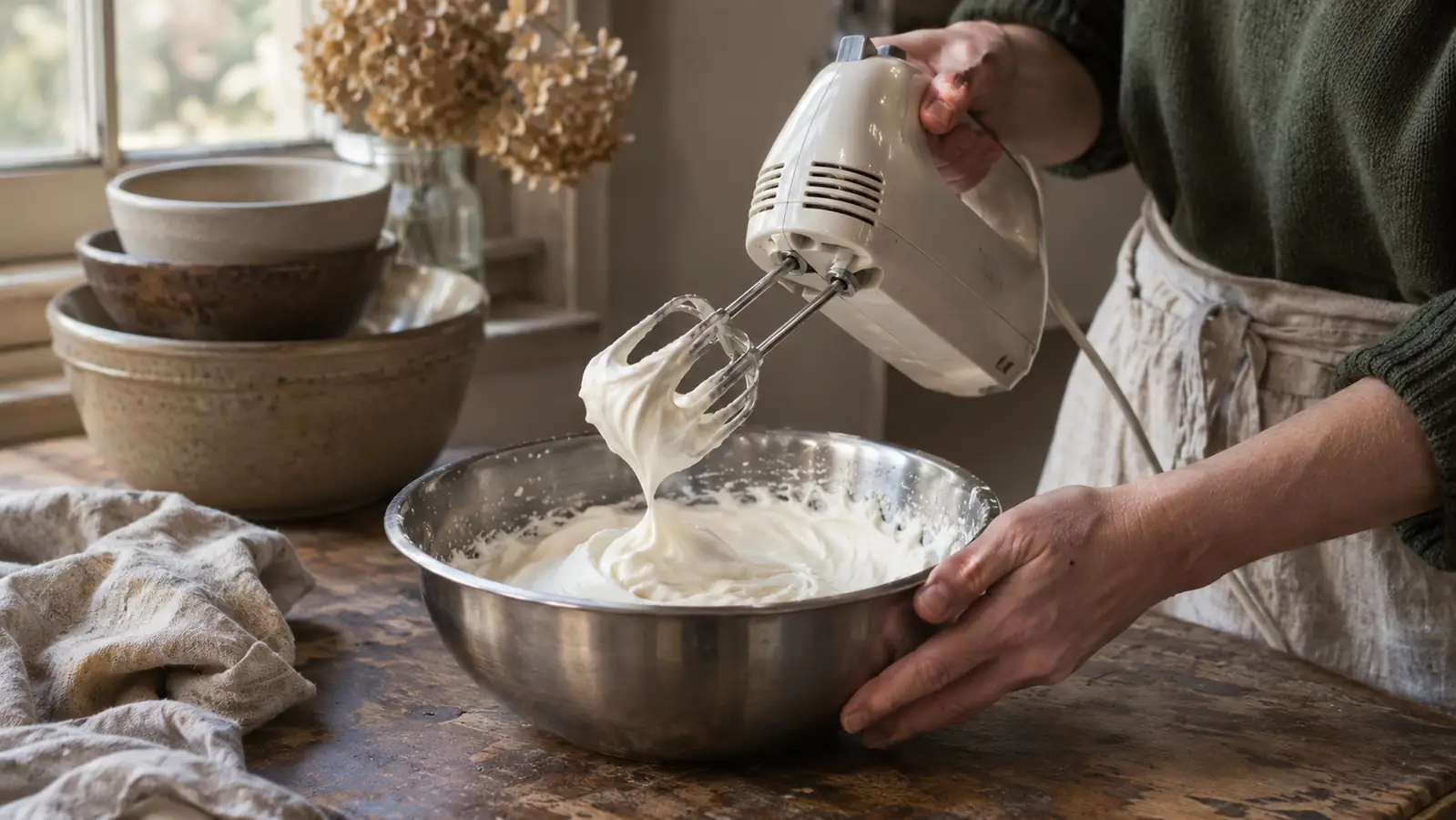
Small batches, first and always. A 5-quart bowl is a lot of empty space when you are whipping one cup of cream, and the beater sits far enough above the bottom that the cream climbs the side instead of getting whipped. Two beaters in a quart bowl do that job in half the time, and you can tilt the bowl and see what you are doing.
Second, cleanup. The stand mixer brings a bowl and an attachment, and the bowl is the size of a small sink. Two beaters rinse off in fifteen seconds. On a Tuesday when I am making one pan of brownies for the two of us, the hand mixer is finished and back in the drawer before the stand mixer would have been unclipped from its base.
Third, it travels. Every October the church has its bake sale, and for years I carried a hand mixer, a bowl and a bag of sugar to the fellowship hall and made frosting on site because the cakes were still too warm to frost at home. That mixer has worked in three kitchens, a church basement and one rented cottage on Lake Erie. Nobody has ever asked to borrow a stand mixer. Two people have asked to borrow the hand mixer, and one of them still has it.
The Counter Space Question
If your kitchen is small, measure before you decide. The Artisan is 14.1 inches deep, 8.7 inches wide and 13.9 inches tall, and the tilt head needs clearance above it to swing back. That last number is the one people forget, and it is why a mixer that fits on the counter can still be awkward under a low upper cabinet.
I measured twice with a tape before I set mine down. My upper cabinets sit at 17 inches, which leaves a little under three inches of clearance for the head to swing back, and it works, but it works by a margin thin enough that I checked the numbers at the store and again at home. If your cabinets are lower than mine, walk through that tilt with a tape in your hand before you buy. A mixer you have to pull forward every single time is a mixer you stop using.
Where people get this wrong is imagining the stand mixer as an appliance they will put away after each use. They will not. It is roughly 22 pounds and too heavy for a daily lift, and the cupboard clearance is usually too tight anyway, so it either lives on the counter or it lives in the basement. If you cannot give it a permanent corner, buy the hand mixer, enjoy the drawer, and revisit this when the kitchen changes.
The other half of the space question is what you actually bake. A hand mixer covers cookies, cakes, muffins, frosting and whipped cream, which is most of what a weekend baker does in a year. The stand mixer adds bread, big batches and hands-free mixing. If bread is not on your list, the counter space is a real cost with no payoff to show for it.
What Neither Mixer Fixes
A mixer does not fix a recipe. An oven that runs 15 degrees hot will still catch the edges of a cake, a thin pan will still brown the bottoms before the middle sets, and guessed measurements will still give you a different result every time. The tool that changed my baking most was a scale, and it sits on a shelf and takes up less room than either mixer.
What a good mixer does is remove the physical part of the work so you can pay attention to the part that matters. It will not improve your flour, your oven, or your timing. It will make the same recipe behave the same way twice, and for anyone baking weekly, that is the thing worth having.
I learned that the slow way, over a stretch of years when I blamed myself for sunken cake middles and pale bottoms and uneven browning. When I finally started weighing flour at 120 grams a cup, the same recipe that had failed four times in a row stopped failing. The heavy pan went into service for anything I planned to hand to another person, and the thin one stayed for bars and brownies nobody would see. Neither fix came from a mixer. Both came from paying attention to something other than the mixing.
Who Should Buy Which
Buy the KitchenAid Artisan if you bake bread at all, even once a month. Also if you double recipes because you are baking for a crowd, if you make layer cakes and want to frost them without your arm giving out, or if you simply want the mixing handled while you do something else. The 10 speeds, the 5-quart bowl and the slow end of that slide control all do the same job, which is taking the long, boring, physical part off your hands.
Stay with a good hand mixer if your baking is one pan of bars, a batch of muffins, whipped cream for a dessert, and a birthday cake once a year. Also if your counter is short, your upper cupboards are low, or you bake in small quantities and do not want to scrape out a big bowl. Nothing on that list is a downgrade. It is a correct answer to a different question.
The case for both, which is where I landed: the stand mixer stays out and handles bread, cookies and anything measured in multiples, and the hand mixer stays in the drawer and handles cream, egg whites and one-bowl jobs. If you can only have one and you bake every week, the stand mixer covers more of the work. If you bake once a month, the hand mixer covers all of it, and it will still fit in the drawer.
One mixer, two loaves, and a free pair of hands on a Saturday morning
The 5-quart tilt-head KitchenAid Artisan with the 10-speed slide control and the dough hook I use every weekend. Measure the counter first, then check the current price.
Amazon See Today's Price on Amazon →